Core HR Agent
What Is Workforce Intelligence And How It Works In 2026?
- 12 November, 2026
- 20 Minutes
 Jamie Ho
Table of Content
71% of leaders rely on instinct rather than workforce insights when making talent decisions.
Despite having access to more workforce data than ever, many organizations still struggle to connect the dots between their people and business performance.
Employee turnover appears in HR reports. Labor costs sit in finance systems. Productivity figures are tracked by operations. Each department sees a piece of the puzzle, yet leaders often lack the bigger picture needed to understand how workforce decisions affect business results.
As workforce challenges become increasingly complex, relying on fragmented reports and intuition is no longer enough. Businesses need a clearer way to understand their workforce, anticipate emerging challenges, and make decisions that support long-term performance.
This article explores how workforce intelligence helps business leaders turn fragmented workforce data into actionable insights. It highlights practical ways C-level executives can make better talent decisions, allocate resources effectively, and support long-term business goals.
Keytakeaways
- Workforce intelligence unifies HR, Finance, and Operations metrics into a single analytical view. Enterprise leaders use these insights to align headcount decisions directly with corporate growth goals.
- Workforce intelligence software moves far beyond basic people analytics. Tailored dashboards deliver clear visibility into labor costs and operational capacity directly to CFOs, COOs, and CEOs.
- Complete workforce intelligence platforms rest on four core capabilities. These pillars include data integration, real-time visibility, predictive planning, and skills intelligence.
- Centralized data streams eliminate manual spreadsheet reconciliation delays across departments. Executive management evaluates headcount budgets and restructuring needs with immediate confidence.
What Is Workforce Intelligence?
Workforce intelligence is the practice of combining employee data with financial and operational information to understand how workforce decisions affect business performance. It brings together data such as headcount, skills, employee performance, compensation, and productivity to give leaders a more complete view of their workforce.
As businesses grow, workforce data is often spread across multiple systems managed by different departments. HR teams track employee information and skills, finance teams manage labor costs, while operations teams monitor project progress and team productivity. Without a connected view of this information, leaders may find it difficult to understand how workforce decisions affect overall business performance.
The difference becomes clear when comparing the insights each approach provides to business leaders. Rather than simply presenting workforce figures, workforce intelligence connects employee data with business priorities to help leaders make more informed decisions.
- Traditional HR reporting: Shows basic workforce information, such as employee headcount by department, turnover rates, and staffing levels.
- Workforce intelligence: Assesses whether employees are allocated effectively based on business priorities, revenue targets, skills requirements, and operational capacity.
The Difference of Workforce Intelligence and People Analytics
As businesses increasingly rely on workforce data to guide decisions, two approaches often come into the picture: people analytics and workforce intelligence. Although they share a common goal of improving workforce decisions, each offers a different perspective on how employee data can support business performance.
Workforce intelligence and people analytics both use workforce data to support better decisions, but they differ in scope, focus, and business impact. People analytics typically focuses on HR-related questions, while workforce intelligence takes a broader view by connecting HR data with financial and operational information.
The table below highlights the key differences between the two approaches:
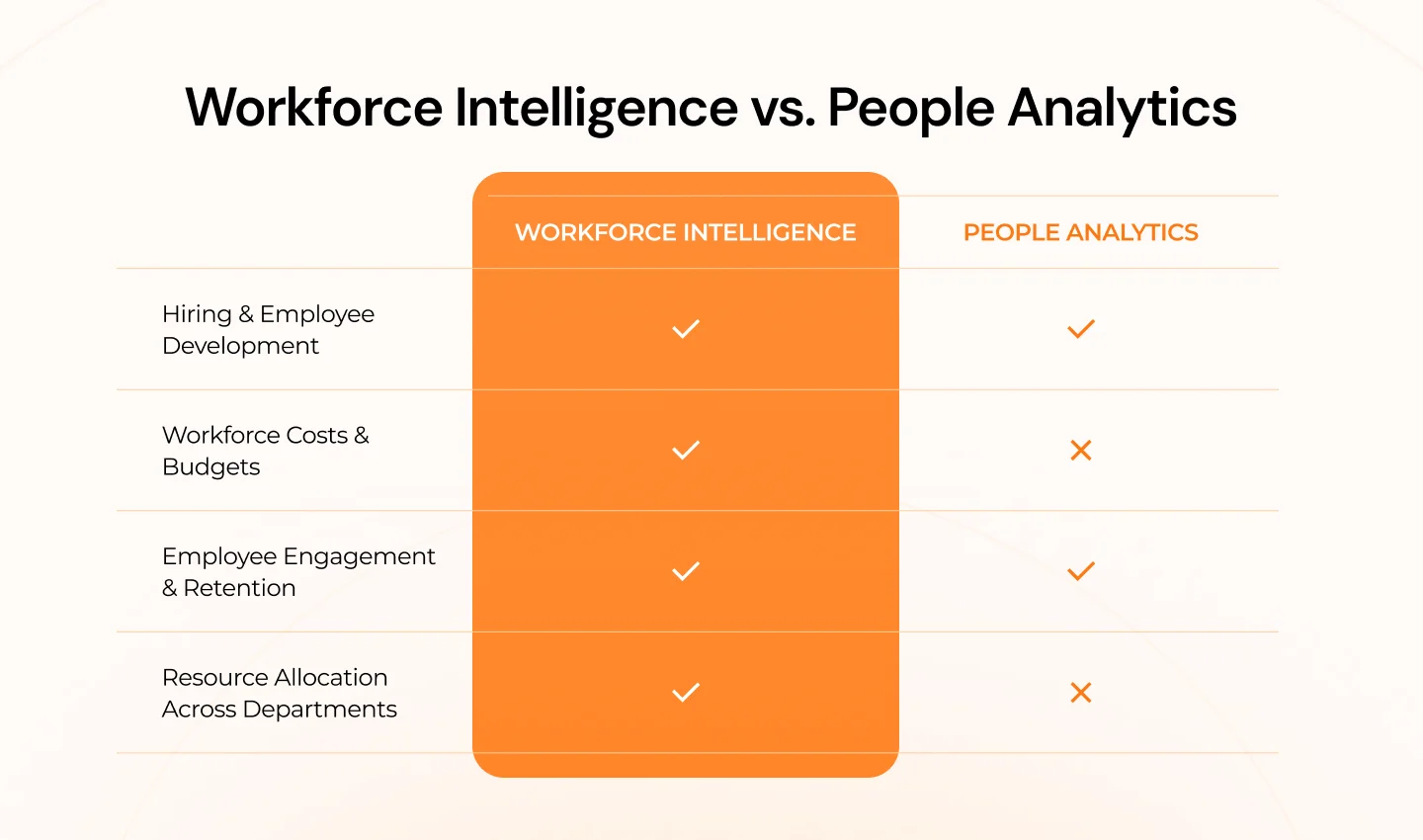
Both approaches help organizations make better use of workforce data, but they support different levels of decision-making.
- People analytics: Helps HR teams understand employee trends, improve recruitment and retention strategies, identify engagement issues, and support workforce development.
- Workforce intelligence: Helps business leaders connect workforce decisions with financial and operational performance, optimize resource allocation, identify capacity gaps, and align workforce planning with business goals.
In practice, these approaches complement each other. People analytics provides a deeper understanding of the workforce, while workforce intelligence connects that understanding to wider business priorities.
4 Core Capabilities of Workforce Intelligence
Business leaders often make workforce decisions with information scattered across departments. Limited visibility into employee capacity, labor costs, and available skills makes it difficult to assess current resources, identify operational gaps, and anticipate future staffing needs. These challenges can affect project delivery, resource allocation, and overall business performance.
A workforce intelligence platform addresses these challenges through four core capabilities. Together, they connect workforce data, provide real-time operational visibility, and give leaders the insights needed to manage resources and plan for future business demands.
1. Unified Data Integration
Executive leaders require continuous data flow across multiple enterprise departments to manage labor expenses, workforce capacity, and operational commitments effectively. Disconnected employee records, financial budgets, and project deliverables force management teams to operate with incomplete operational visibility.
A modern workforce intelligence platform unifies HRIS software, ERP financial records, project tracking systems, and daily operational metrics into a single data layer. Enterprise systems synthesize total headcount capacity, payroll spend, and business goals to eliminate manual spreadsheet consolidation across corporate teams.
For example: Leadership teams can combine employee headcount, labor costs, and project data to assess workforce capacity and identify potential resource gaps. A consolidated view of these figures supports more accurate workforce planning and reduces time spent preparing reports from disconnected systems.
Explore Blazeup to unify HR, Finance, and Operations data, empowering executives to make faster, data-backed workforce decisions.
2. Real-Time Workforce Visibility
Operations directors need an immediate, up-to-date picture of team capacity to keep business activities aligned with fast-shifting market demands. Delayed visibility into workload distribution, employee utilization, and labor expenditure leads to inefficient staffing decisions and delayed execution.
Modern workforce intelligence software provides live operational dashboards that track active headcount, available capacity, staff utilization rates, and payroll spend across enterprise departments. Decision-makers leverage up-to-the-minute data to identify capacity deficits early and reallocate personnel swiftly as operational priorities evolve.
For example: A COO can compare team capacity with active project workloads to identify departments facing resource shortages or uneven workloads. Timely insights support better workload distribution and more responsive operational planning.
3. Predictive Workforce Planning
Corporate growth, market expansion, and new initiative launches create staffing requirements that static headcount budgets fail to foresee. Forward-looking forecasts help executive management anticipate hiring demands, control labor overhead, and prepare necessary skills ahead of revenue expansion.
Structured workforce intelligence planning algorithms analyze corporate growth targets, active project pipelines, and historical recruitment velocity to project future talent needs and competency requirements. Financial officers link talent projections directly to revenue goals to establish a solid baseline for talent acquisition strategies.
For example: A company preparing to enter a new market can forecast staffing needs based on projected demand, expected workloads, and existing workforce capabilities. These insights support more strategic hiring decisions and workforce intelligence planning.
4. Skills and Capacity Intelligence
Shifting corporate priorities frequently demand technical capabilities and expertise beyond a team’s current baseline. Organizations without a clear inventory of internal talent risk overlooking qualified staff and incurring unnecessary external hiring expenses.
An agile workforce intelligence platform relies on automated skill-mapping systems that evaluate active employee capabilities directly against strategic business demands. Executive teams gain complete visibility into emerging skill gaps, underutilized talent pools, and internal mobility opportunities to reassign staff across high-priority initiatives.
For example: A company launching a new project can compare the required skills with existing employee capabilities and availability. This helps identify suitable employees for project assignments, address skills gaps, and reduce unnecessary external hiring.
Workforce Intelligence Planning: 4 Steps to Build an Effective Strategy
A successful workforce intelligence strategy starts with a clear business objective. Organizations need to understand which workforce data is available, what business decisions require better insights, and how different data sources can work together to support those decisions.
For companies managing workforce information across multiple departments, a phased approach makes implementation more manageable. The following four steps help establish a connected data foundation and turn workforce insights into practical business decisions.
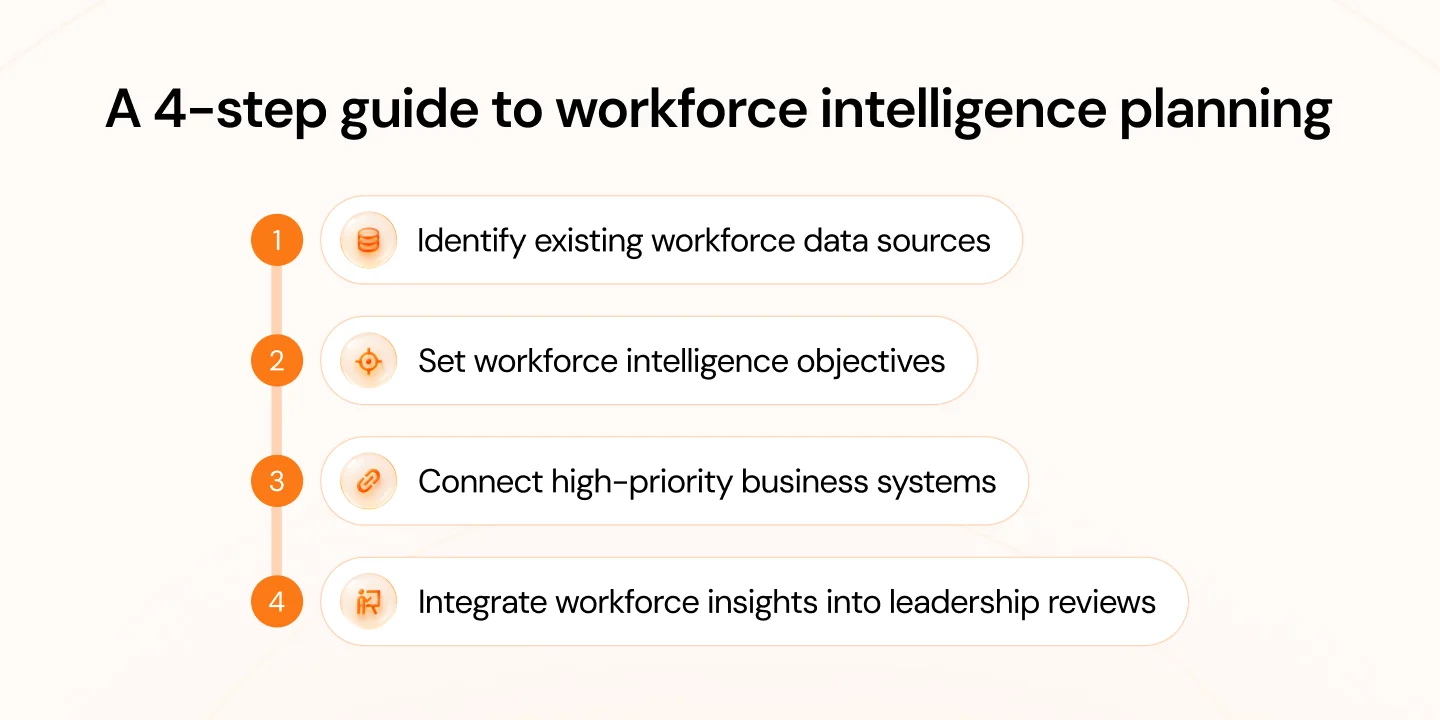
1. Identify Existing Workforce Data Sources
Before choosing a workforce intelligence platform, identify where workforce-related information currently resides. HRIS and payroll systems hold employee records and compensation data, while Finance, CRM, and project management systems contain information about labor costs, business performance, and operational workloads.
Create an inventory of these systems, the data available in each system, and the departments responsible for maintaining that information. A clear data map establishes the foundation for integration and helps identify gaps, duplicated records, and disconnected information.
For example: A company may store employee records in an HRIS, salary information in payroll software, and project workloads in a project management tool. Mapping these sources helps identify which systems contain relevant workforce data and where integration is needed.
2. Set Workforce Intelligence Objectives
Once existing data sources are mapped, determine which business decisions require better workforce insights. Workforce intelligence delivers the most value when insights address questions that matter to executive leadership and connect workforce planning with broader business priorities.
Start with two or three questions frequently raised by the COO, CFO, or other business leaders, such as:
- Is the current headcount aligned with revenue targets and business priorities?
- Does workforce capacity match the demands of the project pipeline?
- Which departments have the highest labor costs relative to output?
For example: A COO preparing for business expansion may need to know whether current teams have enough capacity to support new projects. This question helps define the data required, such as employee availability, existing workloads, and projected project demand.
3. Connect High-Priority Business Systems
With business priorities established, identify the data connections that can deliver the most immediate business value. Connecting HR and Finance data provides a practical starting point, giving leadership a combined view of headcount, compensation, and labor costs across departments.
For example: Integrating employee headcount and salary data with departmental output allows leadership to compare labor costs against business performance. Once the initial integration provides useful insights, project management and CRM data can be added to expand visibility into operational capacity and business performance.
4. Integrate Workforce Insights into Leadership Reviews
Workforce intelligence becomes part of business management when workforce insights are included in regular leadership reviews. Establish a reporting cadence that brings HR, Finance, and Operations leaders together to assess workforce costs, team capacity, resource allocation, and operational demands.
For example: A COO at a 200-person company can use integrated headcount and project workload data during monthly business reviews. Insights into overloaded teams and underutilized resources help leadership adjust staffing plans, redistribute workloads, and allocate resources according to project demands.
Benefits and Limitations of Workforce Intelligence
An integrated workforce intelligence capability strengthens executive decisions by connecting workforce metrics directly with financial and operational performance. The business value spans resource allocation, predictive workforce planning, and strategic talent management.
Successful execution depends heavily on data accuracy, system integration, and cross-functional leadership alignment. Executive teams must balance strategic advantages against technical and operational risks before scaling platforms across the organization.
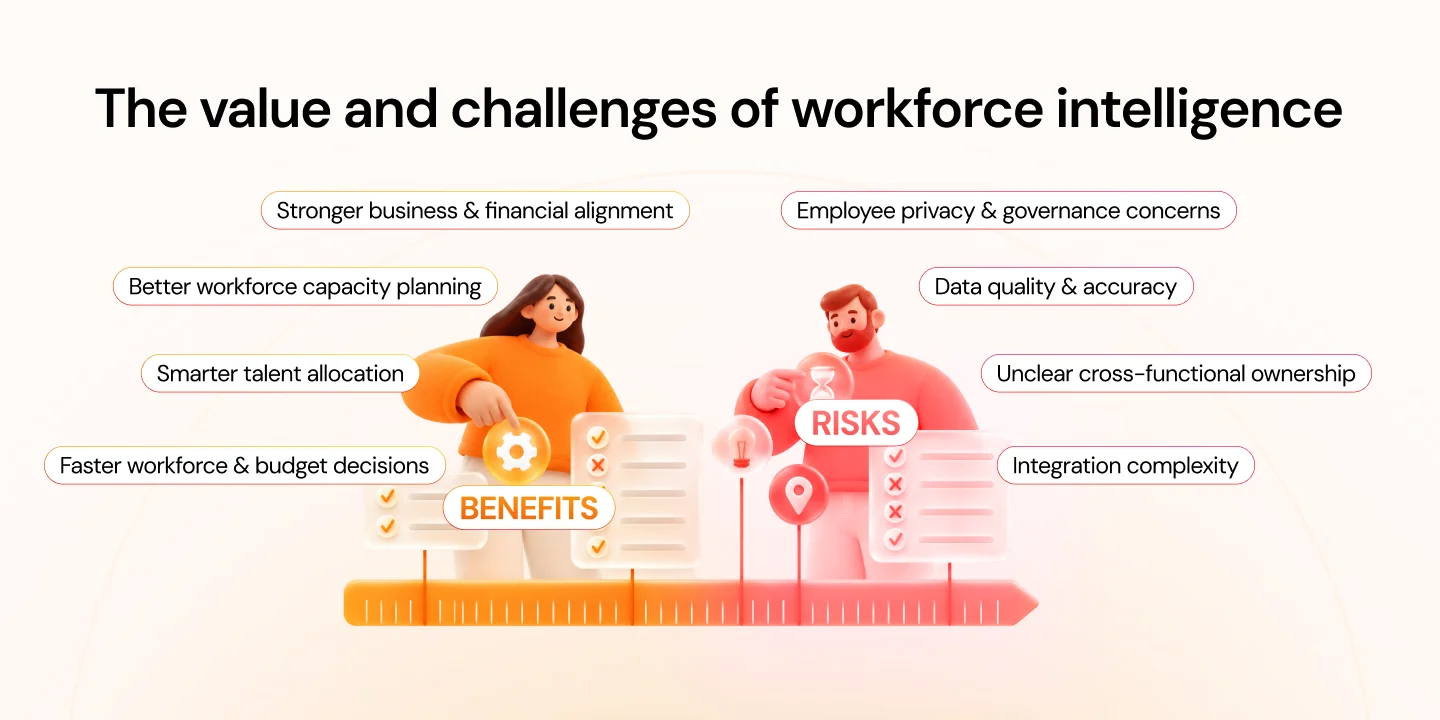
The visual summary below illustrates the key benefits and practical challenges of implementing a workforce intelligence platform. Reviewing these core trade-offs helps leadership evaluate implementation risks and establish a realistic, data-driven roadmap.
Key Business Benefits of Workforce Intelligence
A unified workforce intelligence platform provides business leaders with a connected view of headcount, financial costs, and operational capacity, accelerating strategic decision-making. Core business advantages include:
1. Faster Workforce and Budget Decisions
Business leaders require timely workforce and financial insights to make critical decisions regarding headcount, labor budgets, and resource allocation. Delays in consolidating information across isolated departments slow down strategic planning and impede responses to shifting commercial demands.
An integrated workforce intelligence platform unifies HR, Finance, and operational data into a single decision-ready view, eliminating manual spreadsheet reconciliation. Live insights into headcount costs, total labor expenses, and departmental spending allow CFOs and COOs to assess capacity requirements rapidly and execute agile workforce adjustments.
2. Better Workforce Capacity Planning
Business leaders need to understand whether current workforce capacity can meet operational demands and project requirements. Headcount alone may not reflect actual team capacity, as fully staffed departments can still face resource shortages and excessive workloads.
Connected HR and operational data provide visibility into employee availability, team workloads, and active project demands. These insights help leaders identify capacity gaps, redistribute workloads, and allocate resources more effectively across departments.
3. Smarter Talent Allocation
New corporate initiatives and shifting business priorities frequently require skills missing from current project teams. Without clear visibility into internal capabilities and employee availability, enterprise leaders overlook existing talent and rely on expensive external recruitment to fill emerging skill gaps.
Skill-based workforce intelligence helps executive teams identify employees whose capabilities match strategic requirements and open internal opportunities. By providing transparent visibility into existing skill sets and active capacity, this real-time data layer promotes internal talent mobility and reduces reliance on external hiring.
Modern workforce intelligence software allows HR directors and operations leads to optimize internal talent allocation systematically. Modern platforms match existing workforce capabilities with high-priority projects, maximizing skill utilization while reducing overall talent acquisition costs.
4. Stronger Business and Financial Alignment
Business leaders must understand how labor expenditures directly impact bottom-line financial performance. Isolated financial and operational records obscure critical data, preventing CFOs and COOs from evaluating headcount investments.
Integrated workforce intelligence software unifies labor expenses, employee profiles, and operational metrics into a single executive dashboard. Direct comparisons between workforce costs and commercial output help decision-makers evaluate capacity utilization and align departmental budgets with corporate goals.
Modern workforce intelligence solutions empower executives to replace financial assumptions with clear data transparency. Deploying an integrated workforce intelligence platform ensures that personnel investments drive measurable performance and long-term enterprise growth.
Risks and Strategic Limitations of Workforce Intelligence
Despite its commercial value, workforce intelligence planning requires careful technical preparation and organizational alignment. Executive management must address four critical operational risks to ensure long-term analytical reliability:
Integration Complexity
A modern workforce intelligence platform relies on continuous data feeds across HRIS, ERP, and operational tools. Incompatible formats and complex system architectures make connectivity difficult while increasing the risk of integration failures.
Integration failures leave critical employee records fragmented across departments, preventing dashboards from reflecting real-time conditions. Limited visibility into labor costs, capacity, and performance weakens workforce intelligence planning and leads to poor resource allocation.
To mitigate these technical hurdles, management teams should adopt a phased rollout for new workforce intelligence software. Implementation leads prioritize high-value data connections first before expanding platform scope across the enterprise.
Data Quality and Accuracy
A workforce intelligence platform synthesizes metrics from HR, Finance, and Operations to provide visibility into headcount, labor expenses, and operational capacity. Inconsistent data formats, incomplete personnel records, and outdated financial figures reduce the reliability of these analytical outputs.
Deficient data quality distorts workforce projections and capacity analyses. Business leaders relying on unverified datasets misjudge hiring requirements, overlook operational resource gaps, or allocate budgets based on flawed reports.
Executive leadership must enforce strict data governance across all connected systems. Automated validation routines ensure that workforce intelligence software delivers verified insights to guide enterprise decision-making.
Unclear Cross-Functional Ownership
A workforce intelligence initiative spans HR, Finance, and Operations, with each department contributing distinct operational datasets. Individual teams without designated project ownership lack clear responsibilities for data maintenance, integration timelines, and ongoing system adoption.
The absence of C-suite sponsorship leads to conflicting priorities, delayed platform deployment, and limited cross-functional collaboration. Unclear accountability prevents workforce intelligence software from achieving organization-wide adoption, leaving executives unable to leverage connected insights during strategic decisions.
Executive management must assign a primary C-suite sponsor such as the COO or CFO to lead cross-departmental alignment. Shared operational metrics and clear governance protocols ensure that every team contributes actively to the enterprise workforce intelligence platform.
Employee Privacy and Governance Concerns
A workforce intelligence platform often collects employee activity, workload, and capacity data to assess operational efficiency. Without clear collection policies and transparent communication regarding data usage, these practices raise privacy concerns and weaken employee trust.
Clear governance protocols must define permissible data streams, user access rights, and analytical boundaries. Transparent communication and strict access controls protect employee privacy while sustaining trust in workforce intelligence software initiatives.
Executive leadership should establish an open privacy framework alongside HR and Legal teams. This alignment ensures that workforce intelligence planning focuses on team capacity and operational optimization rather than individual micromanagement.
Conclusion
Workforce intelligence gives business leaders a connected view of workforce capacity, labor costs, skills, and operational performance. By bringing HR, Finance, and Operations data together, organizations can make workforce decisions that better align with business priorities and long-term growth.
The four core capabilities — unified data integration, real-time workforce visibility, predictive workforce planning, and skills and capacity intelligence — provide the foundation for more informed resource allocation and strategic workforce decisions.
For CFOs, COOs, and CHROs still relying on disconnected systems and manual reports, workforce intelligence offers a clearer path from fragmented data to timely business decisions. The result is better visibility into organizational resources, more effective workforce planning, and stronger alignment between people and business performance.
Interested in replacing fragmented HR spreadsheets with automated, real-time operational insights?
Explore Blazeup to streamline your workforce intelligence planning and build a forward-looking enterprise today.