CRM Agent
People Analytics: How Predictive HR Analytics & Machine Learning Are Transforming Workforce Decisions
- 06 November, 2026
- 20 Minutes
 Jamie Ho
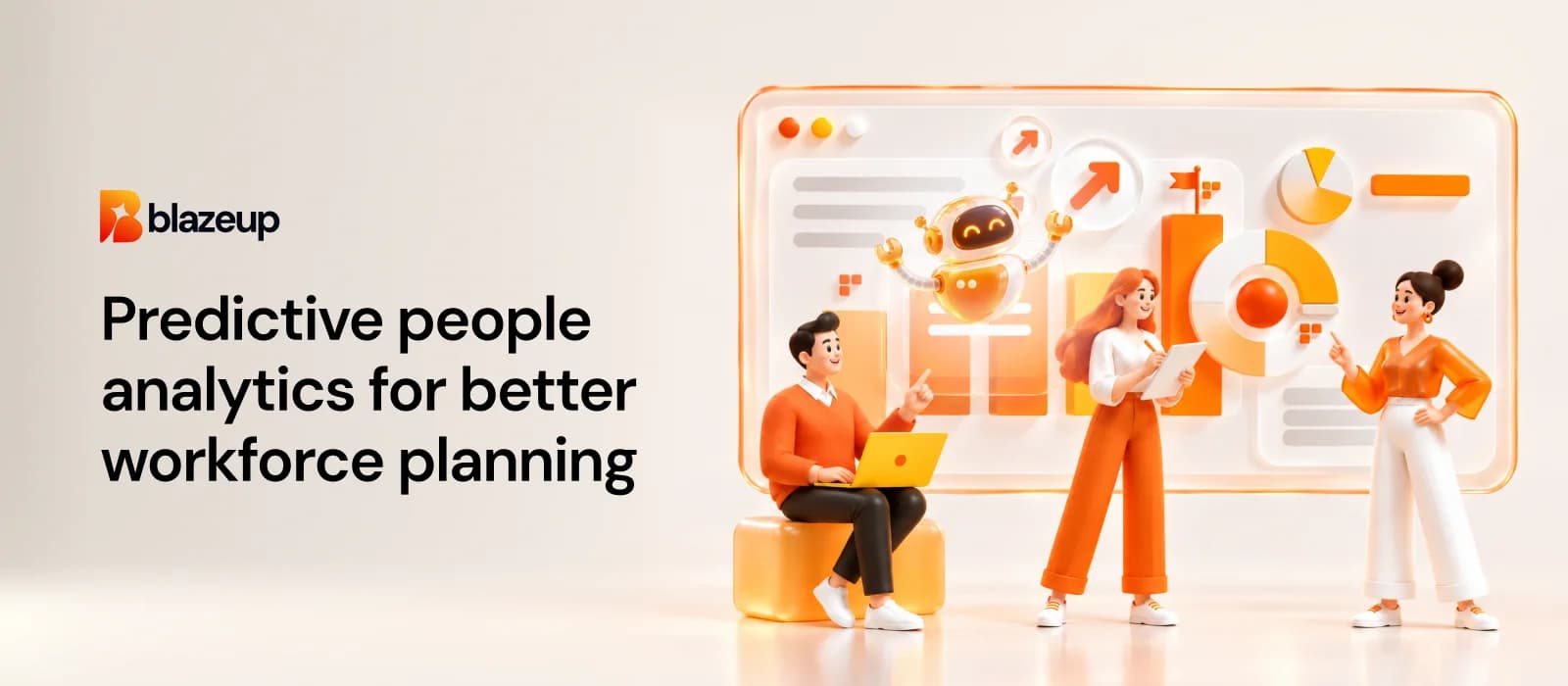
Table of Content
Workforce decisions have a lasting impact on how businesses operate, grow, and compete. Hiring the right people, retaining experienced employees, and preparing teams for future demands all require HR leaders to understand not only what is happening today but also what may lie ahead.
As workforce needs become more complex, relying solely on past reports and traditional HR practices may not be enough. Businesses are increasingly looking for ways to use employee data to identify patterns, anticipate potential challenges, and make better-informed decisions.
Predictive analytics and machine learning are expanding what HR teams can learn from workforce data. These technologies offer new ways to understand employee trends and plan for future workforce needs.
This guide explores how predictive HR analytics works, its key applications in workforce management, the role of machine learning, and the considerations for implementing it effectively.
Key takeaways
- People analytics integrates HRIS data, performance records, and external benchmarks to deliver high-level workforce insights beyond administrative reporting
- Predictive analytics utilizes historical data and machine learning algorithms to shift HR operations from reactive management to proactive strategy.
- Enterprise value concentrates across five primary use cases: attrition forecasting, candidate quality prediction, skills gap identification, headcount planning, and succession tracking.
- Decision trees, Random Forest, and XGBoost architectures surface subtle operational patterns that manual data analysis inevitably misses.
- Advanced analytics adoption enables forward-thinking organizations to maximize retention, streamline hiring quality, and build resilient leadership pipelines.
What Is Predictive Analytics in HR — And How Does It Work?
Predictive human resources analytics utilizes historical data, statistical algorithms, and machine learning models to forecast future workforce trends. Modern predictive analytics in HR platforms aggregate disparate enterprise data streams to illuminate hidden operational risks before impacting financial performance.
Predictive HR replaces subjective management intuition with objective algorithmic forecasting. Automated data pipelines extract raw employee information from multiple corporate platforms, including HRIS software, performance reviews, learning systems, time-tracking tools, and collaboration channels.
The structural diagram below illustrates how enterprise data science teams convert raw HR data into actionable strategic foresight. AI in people analytics engines evaluate these multi-source data streams to detect subtle behavioral patterns that human managers overlook at scale.
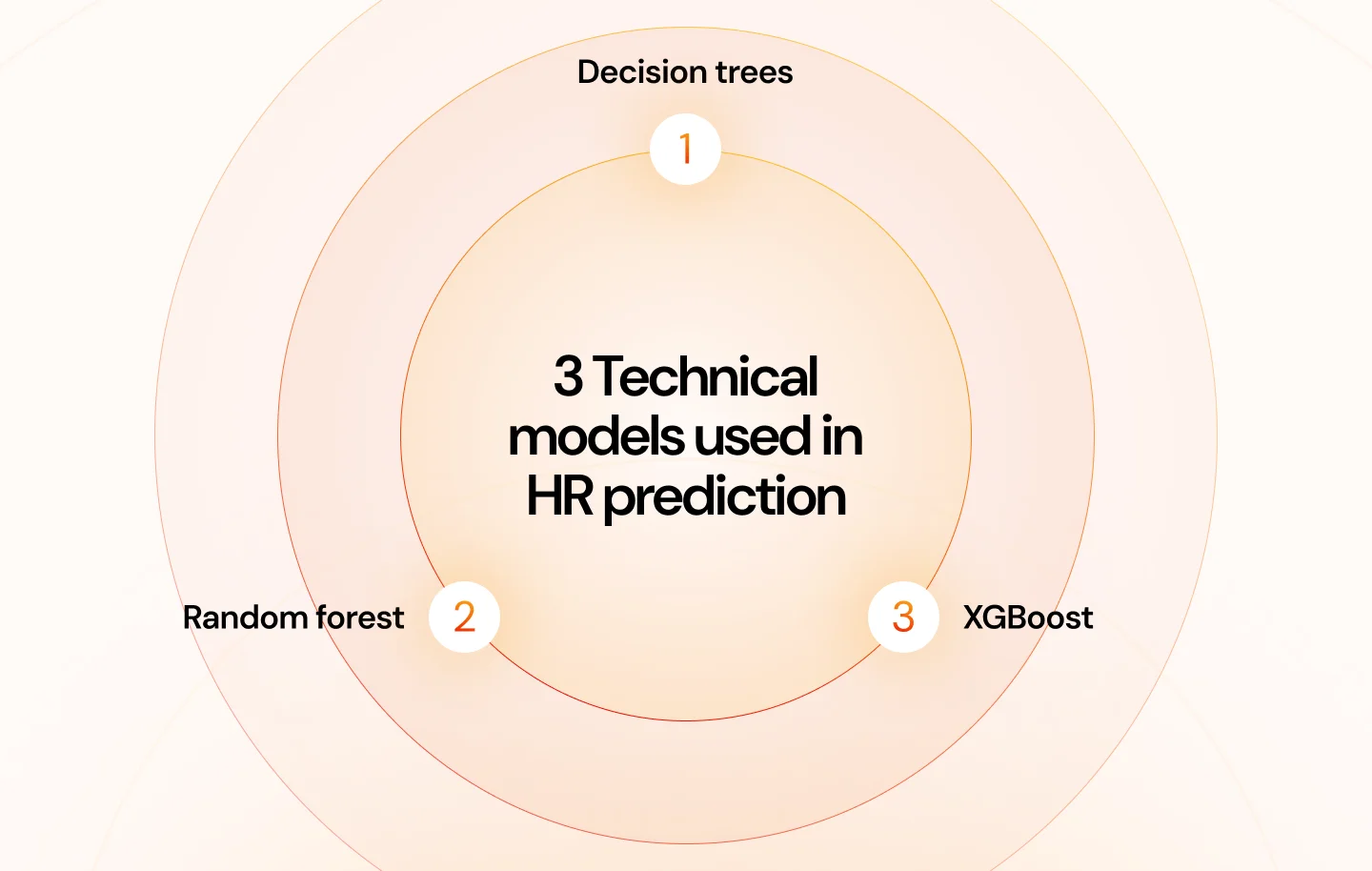
1. Decision trees — sequential rule mapping
A decision tree is a machine learning model that organizes workforce information into a transparent sequence of conditions and possible outcomes. Each branch represents a logical decision rule, allowing system algorithms to classify employee records according to tenure, working hours, or performance history.
The primary organizational advantage centers on model interpretability and analytical clarity. The visual decision structure enables executive leaders to audit classification rules easily before executing sensitive talent retention strategies.
2. Random forest — multi-tree consensus models
Ensemble architectures run hundreds of individual decision trees simultaneously to evaluate complex employee datasets across multiple operational dimensions. Predictive people analytics platforms aggregate outputs across various decision trees to stabilize overall forecasting performance.
Multi-tree consensus mechanisms increase calculation accuracy while preventing statistical bias in smaller talent pools. Deploying this ensemble approach helps organization leaders forecast retention probabilities with higher confidence than single-tree algorithms allow.
3. XGBoost — high-precision gradient boosting
High-performance gradient boosting algorithms process high-dimensional enterprise datasets to uncover complex, non-linear relationships within employee records. Advanced gradient optimization minimizes forecasting errors when analyzing large-scale historical workforce trends.
Iterative model training optimizes prediction accuracy to detect subtle operational signals that traditional analytics frameworks miss. Utilizing machine learning in HR analytics enables enterprise analytics teams to forecast voluntary attrition and future job performance across massive workforce datasets.
5 High-ROI Predictive People Analytics Use Cases
Modern enterprises leverage data-driven workforce forecasting to transform traditional administrative HR into a strategic value center. Deploying targeted predictive analytics models allows executive leadership to mitigate operational risks while optimizing overall labor expenditure.
The diagram below shows how workforce data is used to generate insights that support better business decisions. Automated machine learning models evaluate these multi-source data streams to generate actionable forecasting metrics.
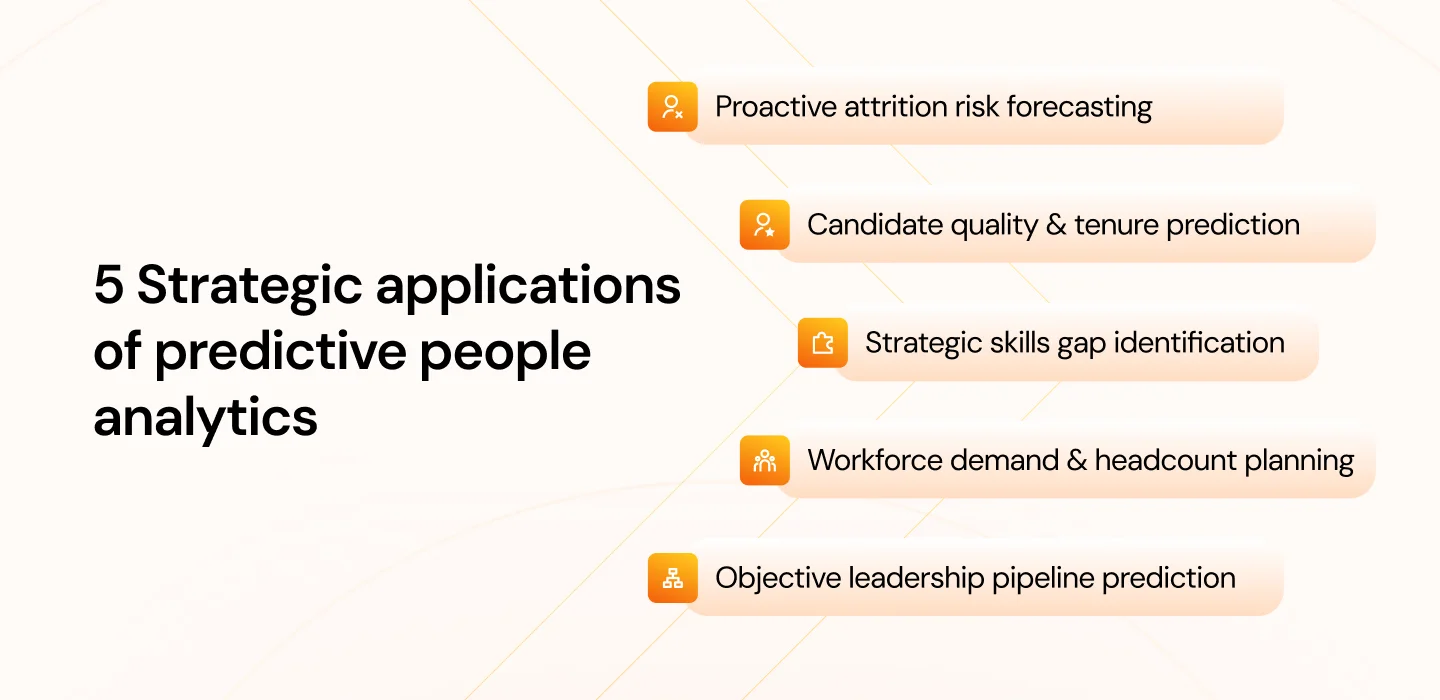
1. Proactive attrition risk forecasting
Early departure indicators enable human resource teams to identify flight risks well before employees submit formal resignations. Predictive analytics in HR platforms continuously monitor engagement trends, manager feedback sentiment, promotion timelines, and market compensation ratios to flag turnover probabilities.
Machine learning algorithms process these combined data inputs to highlight subtle burnout patterns across critical operational teams. Identifying these behavioral signals early empowers department managers to execute targeted retention strategies and protect organizational stability.
For example: A manufacturing plant analyzes overtime trends and tenure milestones to forecast burnout patterns among assembly line technicians. Detecting these fatigue indicators early allows plant managers to deploy retention bonuses before high-performing specialists submit resignations.
2. Candidate quality & tenure prediction
Historical recruitment data helps talent acquisition teams determine which candidate attributes directly correlate with long-term performance. HR people analytics tools analyze sourcing channels, interview assessment scores, and past employment records to forecast candidate success before extending job offers.
Algorithmic screening models evaluate applicant profiles against high-performer benchmarks to streamline early recruitment funnels. Implementing this pre-hire predictive filter reduces costly bad hires while increasing overall quality-of-hire metrics across high-volume roles.
For example: A retail operator evaluates historical candidate sourcing channels against retention metrics to identify high-performing recruitment pipelines. Prioritizing these predictive hiring sources enables talent acquisition teams to increase 6-month employee retention rates across regional stores.
3. Strategic skills gap identification
Continuous evaluation of workplace performance metrics highlights upcoming competency shortages before operational productivity declines. Predictive people analytics frameworks compare current skill inventories against evolving industry standards to pinpoint future talent deficiencies.
Automated gap analysis pinpoints specific skill deficiencies across core departments to guide proactive learning curriculum design. Delivering targeted upskilling initiatives before critical talent gaps emerge prevents expensive operational delays across key business functions.
For example: A logistics enterprise evaluates driver navigation logs and route completion speeds to forecast skill deficits before launching new route management software. Identifying these competency gaps early enables fleet managers to roll out targeted automated training before system deployment disrupts daily operations.
4. Workforce demand & headcount planning
Business expansion projections require accurate labor forecasting to prevent critical staffing shortages during peak operational cycles. Predictive HR models evaluate seasonal sales trends, market expansion goals, and historical hiring velocity to calculate future headcount requirements.
Dynamic demand algorithms calculate precise staffing capacity needs to align recruitment schedules with actual operational requirements. Utilizing this data-driven planning mechanism eliminates emergency hiring expenses and optimizes labor cost allocation across enterprise locations.
For example: A hotel chain correlates local event calendars with advance booking velocity to forecast seasonal frontline labor demands 6 months early. Calculating these headcount requirements in advance prevents staffing shortages and eliminates expensive emergency hiring expenses.
5. Objective leadership pipeline prediction
Rapid skill acquisition patterns frequently signal high leadership potential within operational teams. AI in people analytics algorithms evaluate employee performance trajectories and peer collaboration metrics to identify future leaders based on objective merit.
Algorithmic succession planning removes management bias by systematically tracking individual capability growth across departments. Promoting high-potential talent through objective performance tracking strengthens internal leadership pipelines and improves overall AI employee experience.
For example: A commercial bank tracks customer resolution speed and complex transaction accuracy to spot branch tellers with exceptional leadership potential. Identifying high-performing staff through objective performance data helps talent managers enroll top tellers into accelerated leadership development tracks.
AI in People Analytics — How AI Enhances Prediction Beyond Traditional Models
Artificial intelligence represents a fundamental evolution beyond traditional statistical modeling in human resources analytics. Deploying advanced machine learning models enables enterprise organizations to transform unstructured employee records into actionable executive predictions at scale.
1. Unstructured text sentiment analysis
Natural language processing models analyze unstructured text records, including open-ended survey responses, exit interview notes, and performance review comments. Extracting subtle emotional sentiment and emerging operational themes reveals hidden workforce discontent that structured numeric datasets frequently miss.
Automated text mining converts qualitative employee feedback into standardized risk scores for executive review. Evaluating qualitative feedback trends empowers department leaders to address workplace dissatisfaction before operational productivity suffers.
2. Real-time dynamic risk scoring
Advanced artificial intelligence architectures replace static batch data processing with continuous, real-time risk evaluation. Continuous data stream analysis enables automated platforms to generate instant risk alerts whenever an employee’s behavioral metrics shift.
Receiving real-time notifications allows human resource managers to execute immediate retention measures rather than waiting for quarterly reporting cycles. Delivering timely alerts protects critical operational workflows by mitigating sudden employee departure risks.
3. Natural language data querying
Generative language interfaces allow executive decision-makers to query complex HR databases using conversational English prompts. Executive leaders extract instant workforce insights without requiring specialized SQL expertise or dedicated data science support.
Democratizing data access enables non-technical HR professionals to explore complex talent metrics independently. Simplifying analytics accessibility accelerates strategic decision-making across all operational business units.
Early adoption of AI employee experience technologies provides visionary leadership teams with significant competitive advantages. Organizations leveraging AI in employee experience frameworks optimize long-term labor efficiency while strengthening overall workplace engagement.
Explore Blazeup to automate predictive HR workflows and instantly transform real-time workforce insights into data-backed retention actions.
A 4-Step Guide to Implementing Predictive People Analytics
Transitioning from descriptive reporting to predictive forecasting requires a structured, step-by-step implementation framework. Human resource leaders can establish predictive capabilities without maintaining a dedicated data science team by following a disciplined, phased approach.
The 4-step roadmap below outlines the operational path from data evaluation to active risk intervention. Adopting this practical framework enables talent management teams to prove initial value before scaling predictive analytics across the broader organization.
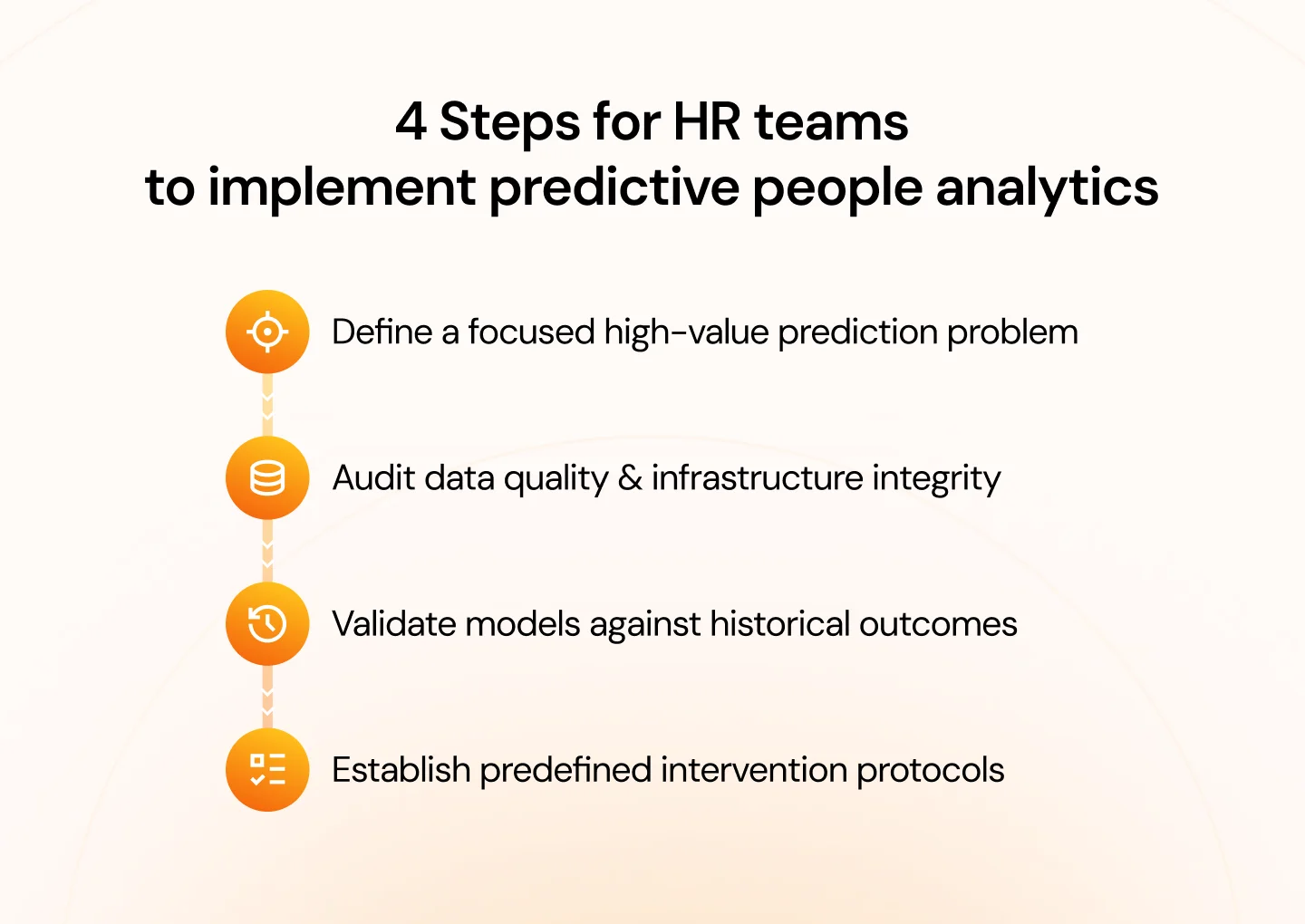
1. Define a focused high-value prediction problem
Human resource executives achieve the fastest measurable analytical ROI when they focus on a single, clearly defined operational challenge. Predictive HR implementations deliver immediate business impact when teams target high-volume scenarios like voluntary attrition risk or candidate hiring quality.
A Head of People at a mid-sized organization achieves optimal results by focusing initially on voluntary departure prediction. Selecting a single focus area ensures that required historical data inputs are already available within existing HRIS software.
2. Audit data quality & infrastructure integrity
Talent acquisition and HR operations teams must evaluate foundational dataset completeness to ensure that downstream predictive algorithms generate reliable operational signals. System administrators audit historical HRIS records, engagement survey response rates, and performance review consistency prior to building forecasting models.
Early identification of missing records and data entry inconsistencies prevents algorithmic bias from corrupting future predictions. Establishing clean data baselines ensures that subsequent machine learning models operate on accurate, enterprise-grade information.
3. Validate models against historical outcomes
Analytics teams test predictive models against historical employee outcomes to validate algorithm accuracy before applying risk scores to current staff. Data specialists run model predictions against historical records from the preceding twelve months to confirm whether the system correctly identified past voluntary departures.
Empirical proof that the model accurately forecasted previous employee turnover builds strong credibility with senior executive leadership. Validating historical accuracy provides the necessary justification to execute proactive interventions based on current risk signals.
4. Establish predefined intervention protocols
Department leaders must define clear management interventions for each risk signal before running predictive models to ensure generated insights lead to direct operational action. Predictive people analytics initiatives fail when organizational leadership receives risk alerts without established protocols to address identified bottlenecks.
Assigning specific retention actions to corresponding risk thresholds empowers department managers to respond immediately when alerts trigger. Establishing structured response protocols converts raw data signals into timely human resource interventions that protect organizational stability.
Risks and Ethical Considerations in Predictive HR
Deploying predictive analytics across human resource operations requires executive leaders to systematically address core ethical challenges and operational risks. People analytics leaders must establish rigorous governance frameworks to navigate algorithmic bias, model explainability, sensitive data privacy, and decision-making boundaries.
The structural analysis below details 4 critical risk categories that enterprise organizations must actively manage. Establishing transparent ethical safeguards ensures that data-driven forecasting strengthens organizational trust while protecting employee rights.
1. Algorithmic bias in HR decisions
Machine learning models trained on historical employee records can encode and amplify past organizational biases in hiring, performance evaluations, and promotion decisions. Empirical research demonstrates that properly designed machine learning algorithms—including XGBoost, SVM, and Random Forest—can actively reduce bias when system administrators execute continuous auditing.
Enterprise analytics teams must implement ongoing monitoring protocols to detect and eliminate systemic demographic skew in model outputs. Regular algorithmic audits safeguard talent pipelines against automated discrimination while supporting equitable workforce decisions.
2. Unexplainable AI predictions and legal risks
Department managers and individual employees require full analytical visibility to understand why an automated model flags a specific worker as a voluntary departure risk. Opaque “black-box” predictions that human resource teams cannot explain erode workplace trust and create significant regulatory and legal liability.
Selecting interpretable analytics architectures enables leadership teams to articulate the precise factors driving each automated risk rating. Transparent prediction mechanisms ensure that management interventions remain defensible, fair, and compliant with enterprise governance standards.
3. Data privacy protocols and regulatory consent
Human resource datasets contain some of the most sensitive personal information that commercial organizations collect and process. Enterprise infrastructure teams must implement role-based access controls, strict data minimization policies, and full GDPR compliance before deploying any predictive model.
Restricting data accessibility protects sensitive employee records from unauthorized internal exposure or external security breaches. Enforcing rigorous compliance baselines maintains organizational data integrity while preserving workforce confidentiality across all operational units.
4. Inaccurate predictions and overreliance on AI
Automated risk ratings represent statistical probability signals rather than definitive operational outcomes. Calculated voluntary attrition risk scores provide strategic warning indicators, not absolute verdicts on an employee’s future tenure.
Executive leaders must utilize predictive insights to inform human decision-making rather than completely automating personnel management actions. Combining data-driven forecasting with genuine managerial empathy ensures that enterprise analytics initiatives optimize workforce performance while prioritizing individual employee well-being.
Conclusion
Data-driven workforce forecasting transforms traditional administrative human resources into a strategic engine for executive decision-making. Transitioning from descriptive reporting to predictive analytics enables management teams to address operational risks before labor costs and productivity suffer.
Core applications—including voluntary attrition forecasting, recruitment quality prediction, skills gap identification, headcount demand planning, and leadership pipeline tracking—rely on a unified technical foundation. Enterprise platforms analyze historical employee records through machine learning models to generate actionable insights before operational challenges escalate.
Successful analytics initiatives do not require massive data science departments or enterprise-scale infrastructure investments. Organizations achieve measurable strategic ROI by focusing initially on a single high-value prediction, validating model accuracy, and scaling analytical capabilities systematically.
For human resource directors currently reporting historical turnover rates as a primary workforce metric, modern technology offers an immediate path forward. Enterprise leadership teams can deploy accessible predictive platforms today to build a resilient, forward-looking talent strategy across any organization size.
Interested in automating workforce forecasting and proactive talent management?
Explore Blazeup to build a resilient, forward-looking predictive HR strategy today.