
Core HR Agent
4 AI Applications in HR That Are Transforming the Workplace
- 19 November, 2026
- 20 Minutes
 Jamie Ho
Table of Content
Organizations expect HR teams to anticipate staffing needs, retain top talent, and drive growth while routine administration still consumes most of their day. Machine learning shifts this dynamic by turning workforce records into actionable insights, enabling people teams to replace reactive routines with proactive talent management.
Artificial intelligence is reshaping this operational landscape by helping businesses connect workforce information, identify emerging patterns, and simplify repetitive processes. These capabilities give HR teams better visibility into their people and more opportunities to focus on strategic talent initiatives.
AI applications in HR use artificial intelligence to improve human resource management processes, from routine tasks to workforce decisions. The application of AI in human resources combines machine learning, Natural Language Processing (NLP), and intelligent automation to streamline operations and analyze workforce data.
This article explores 4 AI applications transforming the workplace in 2026, with practical use cases, leading software platforms, and the business value each application can deliver. From talent acquisition and employee development to workforce planning and everyday HR operations, AI offers practical ways to improve how businesses manage their people.
Key takeaways
- AI streamlines recruitment and talent acquisition through candidate sourcing, resume screening, interview coordination, and automated candidate communication.
- AI improves employee onboarding and HR support with personalized learning paths, automated task coordination, and intelligent self-service assistants.
- AI strengthens employee development and workforce planning by identifying skill gaps, analyzing performance trends, forecasting staffing needs, and detecting potential retention risks.
- Agentic AI connects HR workflows across business systems, enabling specialized AI agents to coordinate tasks and reduce manual handoffs between departments.
- Successful AI adoption requires clear business priorities, reliable system integration, data protection, human oversight, and measurable ROI.
AI Applications Across the Recruitment Process
Modern talent acquisition requires far more than simple resume reviews and manual candidate selection. Surging application volumes often slow down hiring pipelines and make consistent evaluation standards difficult to maintain across growing teams.
The application of AI in HR recruitment uses Natural Language Processing (NLP) and machine learning to support candidate discovery and profile evaluation. Another application of AI in HR is recruitment automation, which helps hiring teams organize applicant data, identify suitable candidates, and accelerate screening decisions.
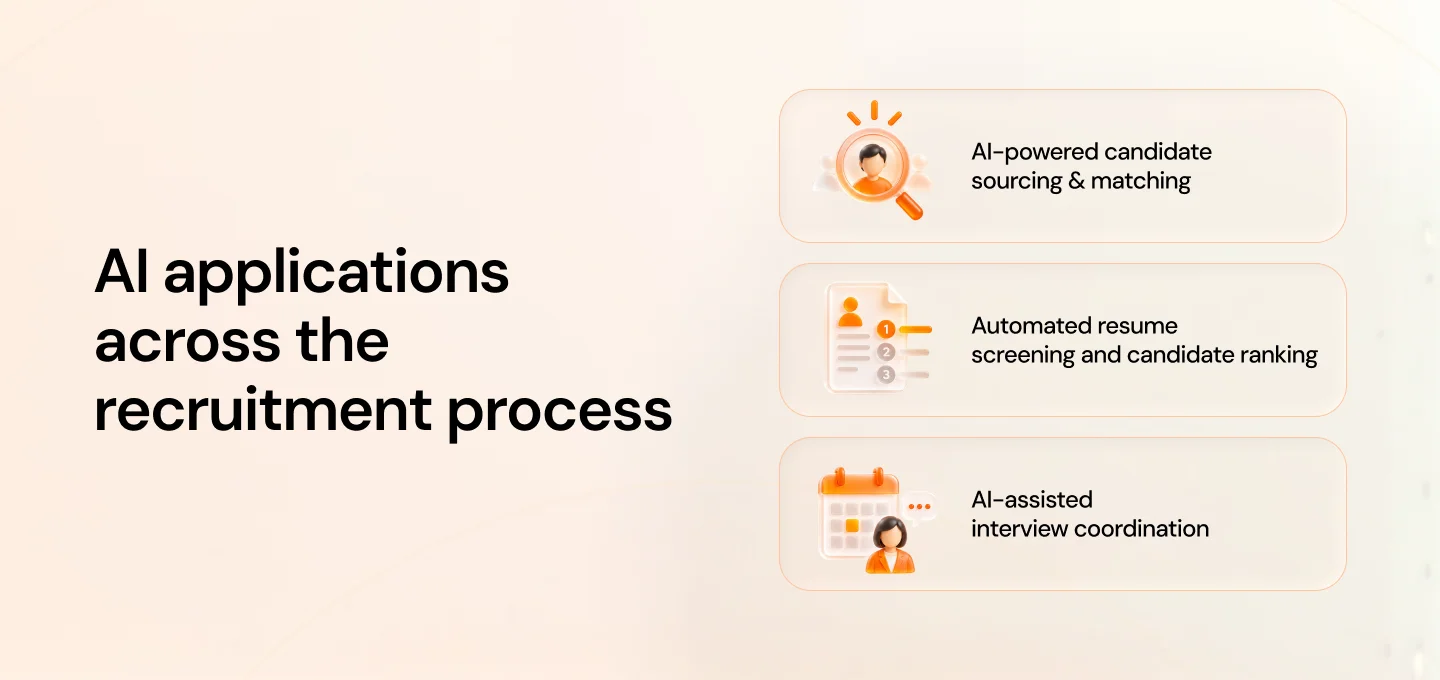
1. AI-powered candidate sourcing & matching
Finding qualified talent typically forces recruiters to search multiple external platforms and manually compare individual profiles against role requirements. Scattered applicant data often delays sourcing timelines before interviews even begin.
AI-powered sourcing tools scan internal and external talent databases to surface profiles matching specific operational needs. Advanced algorithms recognize transferable skills and relevant experience even when candidate resumes use different industry terminology from the job description.
For example: A technology enterprise deploys semantic sourcing software to scan existing talent pools for specialized engineering roles. The system surfaces internal candidates with strong system-architecture experience even when their resumes use varied project terminology.
2. Automated resume screening and candidate ranking
Resume screening remains one of the most time-consuming hiring stages during high-volume recruitment campaigns. Manual reviews frequently create administrative bottlenecks when talent teams manage multiple open positions simultaneously.
AI-powered Applicant Tracking Systems (ATS) extract candidate credentials and score each profile against predefined job criteria. Ranked shortlists give recruiters an organized view of top applicants while human specialists retain final authority over contextual fit and hiring decisions.
For example: A growing logistics firm uses automated resume scoring to evaluate high-volume warehouse applications against core safety and shift requirements. Recruiters immediately review top-ranked profiles while conducting structured interviews to make final hiring selections.
3. AI-assisted interview coordination
Candidate experience directly shapes hiring outcomes across competitive labor markets. Delayed recruiter replies and complicated scheduling logistics often create friction that causes qualified applicants to withdraw.
Automated recruitment assistants sync interview calendars, deliver timely status updates, and answer routine candidate inquiries. Consistent pipeline communication protects employer reputation while allowing recruiters to focus on structured interviews and final talent evaluations.
For example: A regional retail operator uses an automated scheduling assistant to manage frontline store hiring across multiple locations. The digital assistant answers basic shift questions, books interview slots directly onto store manager calendars, and sends timely status reminders to applicants.
How AI Improves Employee Onboarding and HR Services
Employee onboarding requires multiple administrative steps, from preparing employment documents and assigning training materials to coordinating with IT and department managers. Manual follow-ups often lead to inconsistent onboarding experiences for new hires while HR teams spend substantial time tracking routine tasks.
AI in human resources coordinates these activities through personalized guidance, automated task management, and intelligent employee support. These tools deliver role-specific information, answer common questions, and guide employees through essential HR procedures to create a more consistent experience across the organization.
1. AI-powered employee onboarding
A structured onboarding process helps new employees understand their responsibilities, company policies, and workplace expectations. Coordinating individual onboarding requirements across different departments becomes increasingly difficult as hiring volumes grow.
AI-powered onboarding platforms personalize the transition based on job roles, departments, and individual progress. These systems analyze employee profiles and role requirements to recommend relevant training materials, generate tailored task lists, and send automated reminders for pending activities.
Advanced platforms also coordinate document collection, introductory meetings, and system access requests across HR and supporting teams. This automation gives HR specialists clear visibility into onboarding progress, highlighting incomplete documentation, overdue tasks, and employees who need additional guidance.
Standardized workflows enable department managers to deliver a consistent onboarding experience across teams. At the same time, new hires can easily access relevant resources throughout their transition into the organization.
2. AI chatbots and employee self-service
HR teams regularly handle recurring questions about leave policies, payroll procedures, benefits, and internal regulations. Answering these inquiries individually interrupts core HR responsibilities, particularly when employees work across multiple locations or time zones.
AI-powered HR chatbots use Natural Language Processing (NLP) to interpret employee questions and retrieve accurate information from approved company resources. Staff members can ask questions in natural language and receive contextual answers based on internal policies, HR documentation, and verified employee records.
More advanced solutions also guide employees through routine procedures, such as submitting leave requests, checking benefits information, or locating the right forms. Integration with core HR systems enables these assistants to retrieve relevant personnel data and support permitted self-service actions based on access rights.
HR teams can also review recurring inquiry patterns to identify unclear policies, common employee concerns, and gaps in internal communication. This structured approach creates a more accessible support experience while reducing repetitive administrative inquiries.
AI in Learning, Skills Development & Performance Management
Evolving corporate priorities and shifting role specifications require organizations to keep workforce capabilities aligned with operational demands. Conventional development programs often rely on standardized curricula and periodic appraisals, making it difficult to pinpoint individual training needs and close competency gaps early.
AI supports employee development by helping HR teams identify skill gaps, personalize learning opportunities, and monitor performance over time. These capabilities play an important role in 2 areas: building workforce skills and managing employee performance.
1. AI-Powered Learning and Skills Development
Enterprises lacking reliable competency data often struggle to select practical training modules or verify whether education budgets address genuine operational gaps. AI-powered learning systems resolve this issue by assessing individual skill profiles and recommending targeted courses aligned with current capabilities, role requirements, and career goals.
AI-driven learning environments examine worker profiles, role criteria, diagnostic assessments, and course completions to uncover emerging skill deficits. These engines then suggest tailored classes, reference materials, and career tracks matched to individual responsibilities and professional goals.
Adaptive learning algorithms also recalibrate content difficulty based on learner pacing and test outcomes. At an organizational level, predictive analytics detect recurring capability shortages across departments and benchmark current talent pools against upcoming business targets.
These workforce findings steer focused training investments, internal job mobility, and succession pipelines. Companies can consequently prepare staff members for broader responsibilities before skill bottlenecks slow down daily execution.
2. AI-Powered Performance Management
Organizations need more than scheduled appraisal cycles to assess employee contributions accurately. Artificial intelligence enables HR teams to track ongoing output metrics, detect productivity shifts, and pinpoint areas where staff members need coaching or targeted development.
AI-enabled performance systems evaluate structured productivity metrics, milestone tracking, project deliverables, and multi-rater comments to give supervisors a holistic view of individual contributions. Advanced tools also synthesize feedback across diverse sources, surface recurring behavioral patterns, and flag areas where team members require coaching or skill reinforcement.
Automated tracking further assists department heads in monitoring progress toward personal and team objectives throughout the entire review cycle. Pairing these data signals with managerial judgment fosters timelier feedback, clearer growth priorities, and stronger alignment between daily execution and corporate targets.
Final evaluation outcomes still require contextual understanding and direct supervisor review. Human oversight remains vital whenever algorithmic recommendations inform formal ratings or career advancement decisions.
AI in Workforce Planning and Predictive Analytics
Workforce planning is also evolving as organizations combine employees, external talent, and digital labor to meet changing business demands. KPMG identifies integrated workforce planning, dynamic workforce deployment, and workforce intelligence as essential capabilities for organizations seeking to align workforce decisions with business priorities.
AI-powered workforce analytics unify data across HR platforms, financial ledgers, and operational systems to uncover staffing patterns and project future requirements. These analytical capabilities show business leaders where extra talent is needed, which departments face capacity bottlenecks, and how headcount adjustments impact operating budgets.
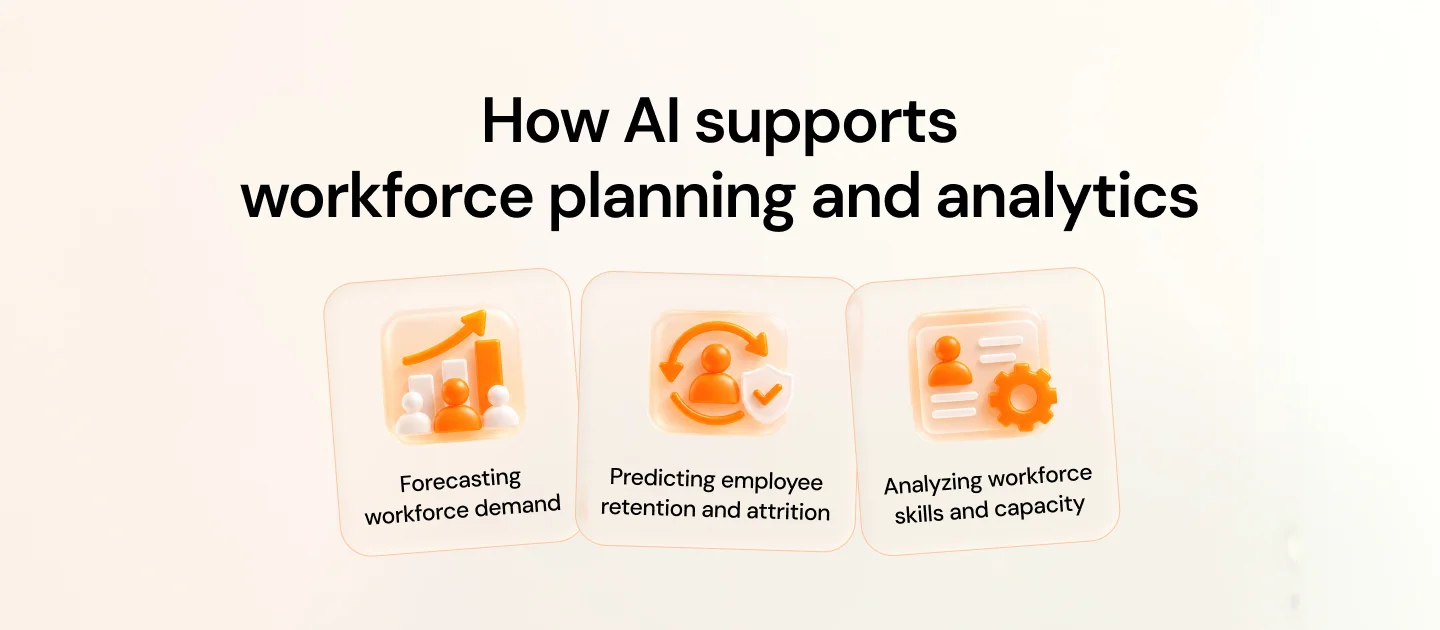
1. Forecasting workforce demand with AI
Labor demand frequently fluctuates alongside seasonal activity, market expansion, project pipelines, and shifting customer orders. Organizations lacking accurate projections risk severe understaffing during peak cycles or excess payroll costs when operational volume slows down.
AI-driven forecasting engines examine past staffing levels, worker availability, workload trends, and commercial growth indicators to estimate future headcount needs. Predictive models detect recurring hiring patterns and flag potential capacity shortfalls across departments, regional branches, or specific job functions.
These projections guide HR and operations executives in scheduling recruitment timelines, calibrating staffing ratios, and deploying personnel according to expected demand. Linking headcount forecasts with financial planning also gives decision-makers clear visibility into projected labor expenses and the budget required to sustain business expansion.
2. Predicting employee retention and attrition
Voluntary turnover drives up recruiting expenses, disrupts team continuity, and slows down output whenever critical roles stay vacant. Conventional retention practices often depend on exit interviews and scheduled engagement surveys, which usually surface dissatisfaction only after staff members have already decided to leave.
AI-enabled attrition models evaluate workforce signals such as employee tenure, pulse survey feedback, compensation shifts, career progression, attendance logs, and historical departure records. Machine learning algorithms pinpoint specific combinations of factors linked to elevated departure risk and highlight teams or roles requiring closer attention.
HR leaders can apply these findings to investigate underlying retention barriers, review career growth paths, and prioritize targeted staff support programs. Algorithmic outputs serve strictly as early diagnostic signals rather than definitive judgments about individuals, supported by rigorous safeguards for data privacy and fairness.
3. Analyzing workforce skills and capacity
Enterprises require clear visibility into both the competencies available across their talent pool and the bandwidth needed to execute business priorities. Basic personnel records alone rarely provide a complete picture of current proficiencies, active project commitments, or access to specialized expertise.
AI-powered skills and capacity systems consolidate information from worker profiles, competency evaluations, project assignments, and workload logs. These platforms map existing staff capabilities against role criteria, uncover skill deficits, and reveal where teams hold spare bandwidth for new assignments.
This operational visibility enables department heads to deploy talent across initiatives, spot internal mobility opportunities, and decide whether capability gaps call for upskilling or external hiring. Connecting skills and capacity data with demand forecasts further strengthens long-term recruiting strategies and balanced resource allocation.
How Blazeup Brings Agentic AI into HR Operations
HR teams often struggle to reconcile personnel records, chase pending approvals, and keep tasks moving when daily operations run across disconnected software. Growing enterprises encounter increasingly complex cross-departmental dependencies, creating an urgent demand for unified execution across everyday people operations.
Blazeup addresses this operational friction through an AI-powered business operations platform that links personnel, corporate data, and multi-step processes in one place. At the core of this workspace sits Blazey, an intelligent assistant that interprets plain-language prompts, directs specialized AI agents, and executes tasks across integrated enterprise applications.
Blazey: An AI execution layer for HR operations
This digital worker operates as an active execution layer inside the platform, guiding HR teams from initial requests to completed outcomes through natural-language interaction. Staff members and department leads simply state what needs to happen rather than manually switching between separate applications to trigger each step.
The assistant interprets organizational context and mobilizes specialized agents to retrieve personnel records, structure HR inquiries, and route tasks across linked software. This conversational interface gives people teams a direct way to manage daily operations while keeping underlying records and processes synchronized.
Specialized AI agents for connected HR workflows
The platform deploys purpose-built AI agents tailored to distinct business functions and operational duties. Each autonomous agent handles targeted tasks and multi-step routines, enabling HR initiatives to link seamlessly with external departments whenever cross-functional collaboration is required.
Linked agents orchestrate cross-departmental actions—such as HR paperwork, IT system provisioning, and manager scheduling—across relevant platforms. This coordinated execution cuts down manual handoffs and gives teams clear visibility into real-time task progress.
Connecting HR with the wider business
People operations rarely function in isolation within modern enterprises. New-hire integration, headcount planning, and internal service requests frequently rely on data and approvals from Finance, IT, Project Management, and engineering teams.
This operations system bridges these silos through native integrations with existing workplace tools, including Slack, Microsoft Teams, Microsoft 365, Google Workspace, Jira, and GitHub. The unified ecosystem lets AI agents operate with full business context across platforms, helping organizations streamline execution without replacing the software their teams already rely on.
Bringing corporate data and specialized agents into a single operational environment allows HR teams to run daily processes smoothly. Business leaders simultaneously gain a clear, holistic view of how people initiatives drive broader organizational objectives.
Explore Blazeup to discover how connected AI agents coordinate workflows, connect business systems, and help teams manage operations more efficiently.
How to Choose the Right AI Applications for Your HR Function
Selecting AI applications requires a clear understanding of business priorities, existing HR processes, and the operational challenges that technology needs to address. Organizations should evaluate how each solution fits their workforce strategy, integrates with current systems, and delivers measurable improvements across HR operations.
The following steps can help guide the selection process:
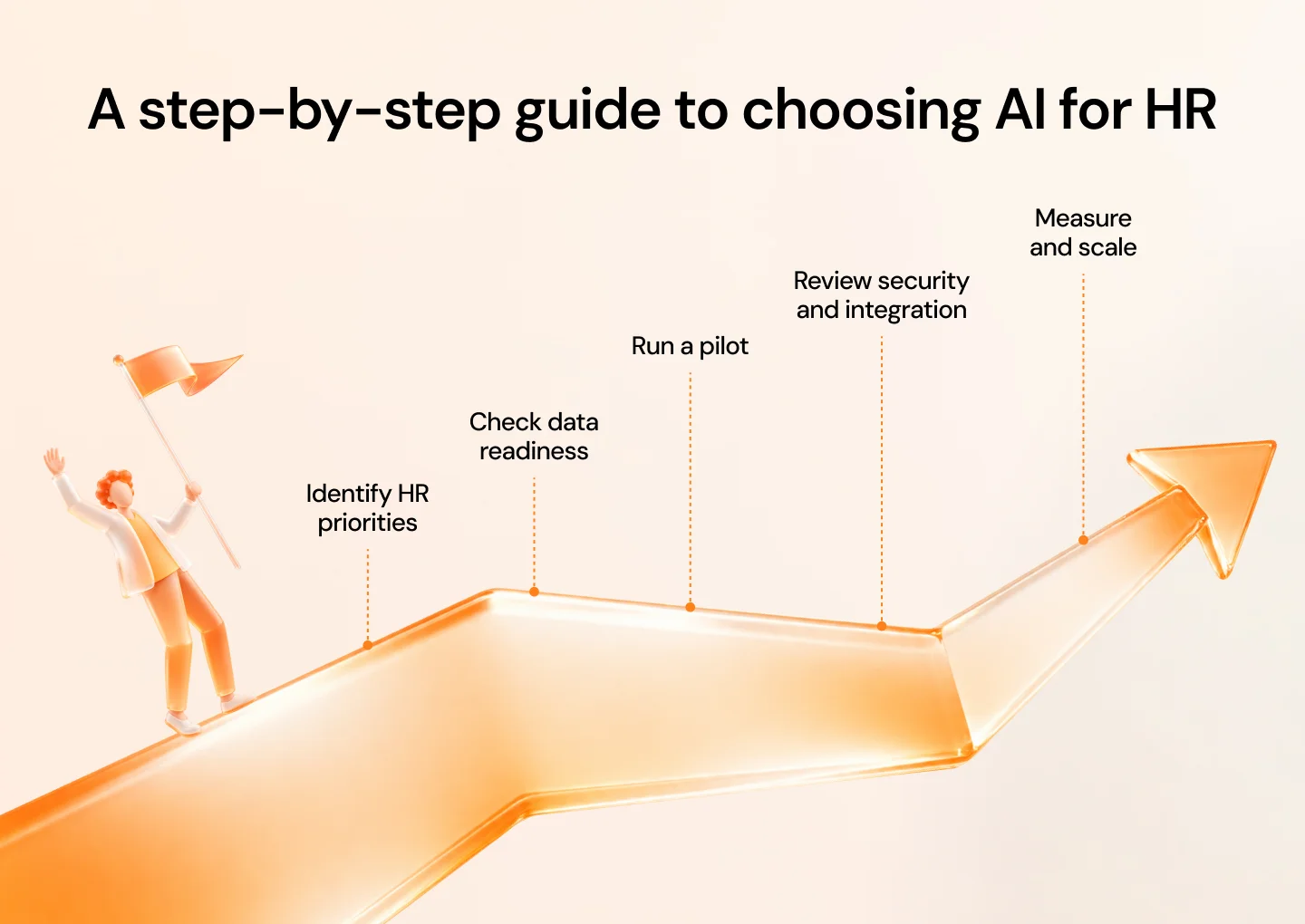
1. Identify HR priorities
AI investment should focus on HR challenges that have a measurable impact on operational efficiency, workforce stability, or business performance. Reviewing existing processes helps identify where manual workloads, recurring delays, or gaps in workforce visibility create the greatest need for improvement.
Example: Organizations experiencing prolonged hiring cycles may prioritize AI-powered candidate screening to reduce recruitment bottlenecks. Businesses facing unpredictable staffing shortages may benefit more from workforce forecasting to align employee capacity with operational demand.
2. Check data and system readiness
The effectiveness of an AI application depends on the quality of its input data and its compatibility with the organization’s existing infrastructure. HR teams should assess data completeness, system compatibility, implementation requirements, and available resources to determine whether a solution can deliver reliable results without substantial additional investment.
For example: Predictive attrition models require historical employee data to identify patterns associated with turnover. Organizations with fragmented or incomplete workforce records may need to improve data consistency before relying on predictive insights for retention planning.
3. Run a pilot
A pilot program provides an opportunity to assess an AI application’s performance, practical value, and suitability for existing HR workflows before committing to wider adoption. Testing within a defined scope also allows organizations to identify limitations, gather stakeholder feedback, and establish realistic expectations for implementation.
For example: An HR team can pilot an employee self-service chatbot to handle routine inquiries about leave, benefits, and company policies. Evaluating response accuracy, resolution rates, and the volume of inquiries handled without HR intervention can reveal whether the application delivers meaningful operational improvements.
4. Review security and integration
AI adoption introduces requirements for system interoperability, employee data protection, and accountability that must be addressed before implementation. Organizations should review vendor security standards, data access controls, integration capabilities, and human review mechanisms to ensure the application aligns with internal policies and regulatory obligations.
For example: AI recruitment software should integrate with the existing applicant tracking system while maintaining appropriate access to candidate records. Recruiters should retain oversight of screening recommendations to ensure candidate evaluations remain transparent, consistent, and subject to human review.
5. Measure and scale
Organizations should define measurable success criteria to evaluate whether an AI application delivers sufficient operational and business value to justify continued investment. Comparing baseline performance with pilot results across productivity, accuracy, cost, service quality, and employee experience provides a clearer basis for determining its long-term value.
For example: Businesses evaluating AI resume screening can compare screening time, time-to-shortlist, recruiter workload, and candidate quality before and after implementation. Applications that demonstrate consistent improvements and meet established performance targets can then be expanded to additional HR teams or processes, with ongoing monitoring to maintain effectiveness.
Conclusion
AI is reshaping human resource management by helping organizations improve recruitment, employee development, workforce planning, and everyday HR operations. From intelligent data analysis to coordinated workflows, these AI applications in HR give business leaders better visibility into workforce needs while reducing repetitive administrative work.
Successful AI adoption depends on selecting solutions that align with business priorities, connect with existing systems, and support responsible decision-making. Organizations that approach implementation with clear objectives can build more responsive HR operations and allocate resources more effectively as workforce needs evolve.
Blazeup supports this transition through a connected AI-powered business operations platform. With Blazey coordinating specialized AI agents across existing business systems, HR teams can simplify operational workflows, access relevant business context, and coordinate work across departments.
Interested in smarter HR operations? Explore Blazeup to discover how connected AI agents can support smarter business operations.
 Sathvik Bellave