
Core HR Agent
AI Agent Architecture & Environment: How Agents Are Built and Where They Operate
- 26 November, 2026
- 20 Minutes
 Sathvik Bellave
Table of Content
In 2025, building an AI agent mostly meant choosing an architecture: deciding how perception, memory, learning, planning, and action were organized and coordinated. But by 2026, the industry had learned a hard lesson: architecture alone is not enough. An agent that works perfectly in a controlled demo often fails completely in a real business setting. This article explains how AI agents are structured internally and the specific types of agent environments in AI they operate in: the two critical decisions that determine whether an agent succeeds or stalls in production.
In this blog, we explore the 5 core pillars of agent design, the 3 primary architectural models: Reactive, Deliberative, and Hybrid, and how specific environmental properties like observability and sequencing dictate whether an agent succeeds or fails. We also examine the PEAS framework and the shift toward multi-agent orchestration as the new standard for mastering complex business workflows.
The reality is that the architecture of agent in AI and the environment it operates in are 2 separate decisions. For a developer, this is a blueprint for building systems that actually survive production. For a COO or HR manager, this is the evaluation framework needed to determine if an agent is built for a specific use case. Confusing these two is why most enterprise deployments stall.
Key Takeaways
If there is only a minute to spare, here is the high-level summary of what to know about artificial intelligence agents and environments:
- Internal Structure Matters: Architecture is the engine that allows an agent to observe, think, act, and learn in a continuous loop.
- Five Core Pillars: Every reliable agent relies on perception, memory, planning, action, and communication.
- Three Main Models: Agents are generally built as reactive, deliberative, or hybrid systems.
- Environment is Context: A fully observable environment in AI allows for simple designs, while a partially observable environment in AI requires deep memory and inference.
- The Mismatch Trap: The most common reason enterprise projects fail is deploying an agent architecture that is too simple for the complexity of the business environment.
What Is AI Agent Architecture?
AI agent architecture is the structural design of an autonomous agent. It defines how the agent receives information, decides what to do, and takes action by integrating sensors, processing mechanisms, and actuators.
At a basic level, an AI agent has 3 core parts:
- It takes in input: data, instructions, or context.
- It processes that input using a model, such as a Large Language Model (LLM).
- It produces an action or response.
The architecture is what connects these parts into a working system. It determines how information flows and how the agent interacts with other tools. Many people confuse agents, models, and systems. The model provides reasoning capability; the agent uses that capability to perform tasks; and the system is the full environment where multiple agents work together. Unlike traditional automation, which follows fixed rules, agent-based systems can adapt in real time to dynamic and unpredictable environments.
The 5 Core Components of Every AI Agent
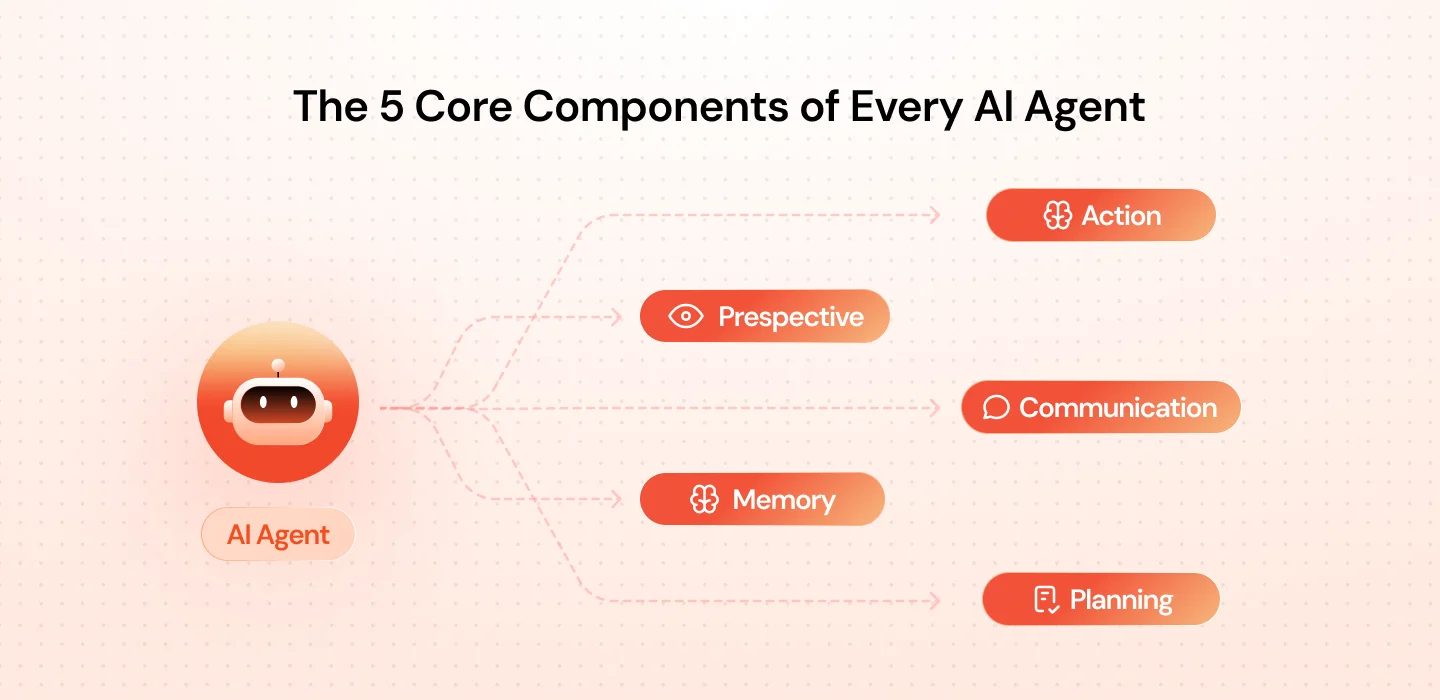
To understand how these agents operate under the hood, they must be viewed as a modular system where each component plays a distinct role.
- Perception: Translates raw inputs like text, audio, or visual data into structured information. This is how the agent “sees” its world.
- Memory: Includes working memory for live context and persistent memory (often via vector databases) for long-term recall.
- Planning: Maps goals to actions using rule-based flows or “chain of thought” logic to decide the best path forward.
- Action: Connects to external tools like CRMs, APIs, and databases to execute steps.
- Communication: Enables interaction with users, other agents, and external systems via messaging protocols and API calls.
These components work in a constant loop: receive input → recall context → plan action → execute → learn from outcome. For example, Blazeup’s Core HR Agent uses this loop to perceive an employee query, recall company policy from memory, plan the resolution, and execute the update in the HR database.
3 AI Agent Architecture Models — Reactive, Deliberative & Hybrid
AI agents differ in how they process information and make decisions. At a high level, the difference comes down to whether the agent reacts immediately or plans ahead.
1. The Reflex Agent in AI (Reactive)
A reflex agent in AI responds to inputs immediately using predefined rules. They are stateless, meaning they have no internal model of the world and do not store past context. While fast and cost-efficient, they struggle with complex workflows that require understanding past interactions. They are best for simple, rule-based tasks like spam filters.
2. Deliberative Architecture
Deliberative agents maintain an internal world model and plan sequences of actions toward a goal. They evaluate different options and consider outcomes before acting. This is slower but handles complexity well, making it ideal for logistics planners or financial modeling.
3. Hybrid Architecture
Hybrid agents combine reactive speed with deliberative planning. For most SME business use cases: HR, finance, and customer service: this balance is the practical choice. It allows the agent to handle routine tasks quickly while maintaining the capacity for complex, long-term reasoning.
AI Agent Environments — Types & Why They Matter
The agent environment in AI includes everything the agent perceives and acts upon. Its specific properties determine which architecture will succeed.
Instead of treating the environment as a simple backdrop, engineers and managers must evaluate it across three distinct operational dimensions to ensure an agent functions correctly in production.
1. Information Accessibility: Fully Observable vs. Partially Observable
This property defines how much of the operational landscape an agent can see at any given moment before making a decision.
- Fully Observable Environment in AI: The system has immediate access to 100% of the relevant data across the entire state of the world at all times. A classic example is a game of chess, where every piece and position is completely visible on the board. In this scenario, the agent does not need to guess or remember past states; it simply acts on current data.
- Partially Observable Environment in AI: Most corporate and enterprise settings are strictly partially observable. An agent typically only sees a small fragment of the situation at one time: such as processing a single incoming chat window or an isolated email ticket. It lacks the broader historical context, such as the full narrative of a legacy payroll dispute or past IT infrastructure changes. To succeed here, the agent cannot just look at the live input; it must actively rely on internal, persistent memory modules to fill in the missing blanks.
2. System Predictability: Deterministic vs. Stochastic
This property dictates how reliably an action translates into a specific, known outcome.
- Deterministic Environments: Every action taken results in a completely predictable, fixed next state. If you execute a specific command in a controlled database script, the outcome is guaranteed to be the same every single time.
- Stochastic Environments: The system involves fluid variables, probabilities, and real-world uncertainty. Financial forecasting or dynamic customer support queues are heavily stochastic. The exact same action can yield vastly different results based on external, shifting market forces or human emotional states that the agent cannot fully control.
3. Action Dependency: Episodic vs. Sequential
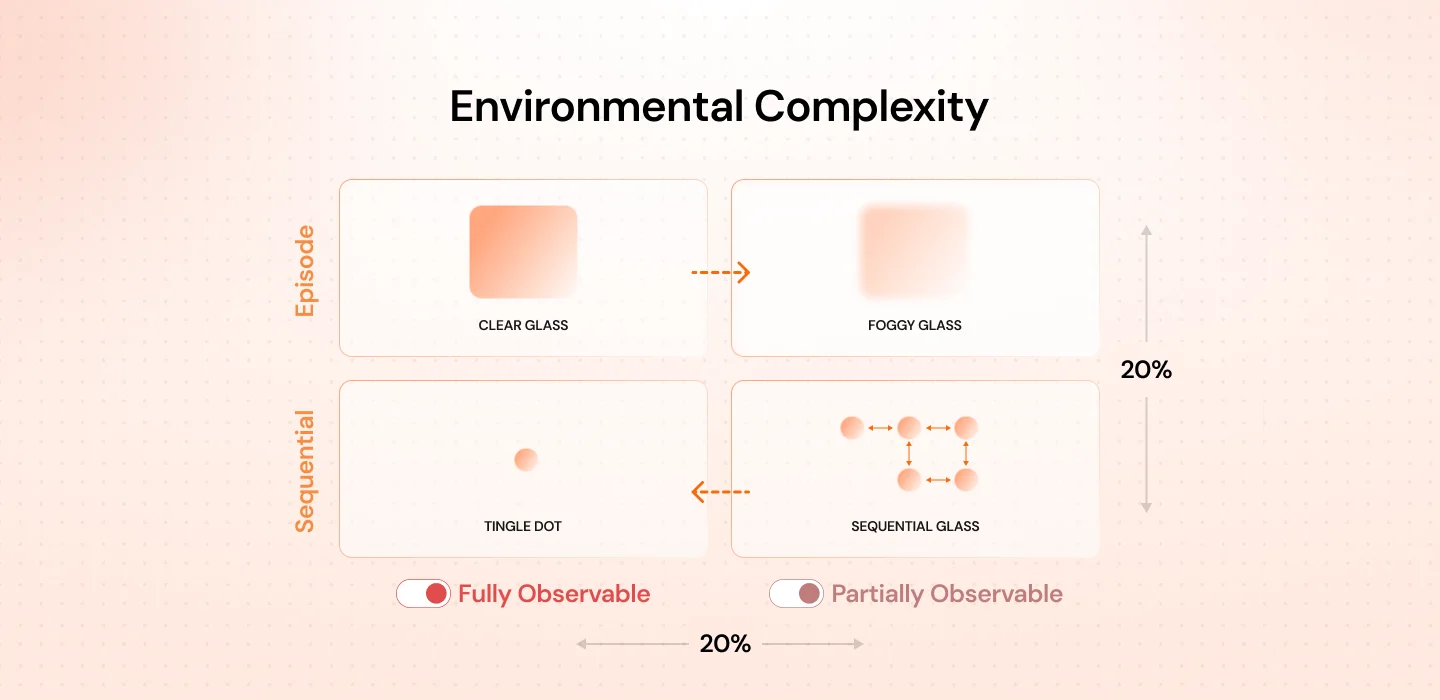
This property measures whether an agent’s current choice will impact its operational future.
- Episodic Environment in AI: Every task or transaction occurs in a complete vacuum. Each interaction is independent, self-contained, and has no carry-over effect on what comes next. For instance, a basic spam filter treats each incoming email as a brand-new event, meaning its decision to block Email A has zero architectural or systemic impact on how it evaluates Email B.
- Sequential Environments: Current actions directly shape, limit, or alter all future states of the system. Corporate operations are almost exclusively sequential. For example, a minor data-entry oversight by an agent on an initial HR onboarding document directly cascades into payroll errors, tax non-compliance penalties, and broken performance tracking workflows months down the line. Each step builds on the last, requiring long-term strategic planning.
Technical Scoping Frameworks and Orchestration
To deploy an agent successfully, organizations must formally map out environmental parameters and team structures.
The PEAS Framework — Defining an Agent’s Environment Formally
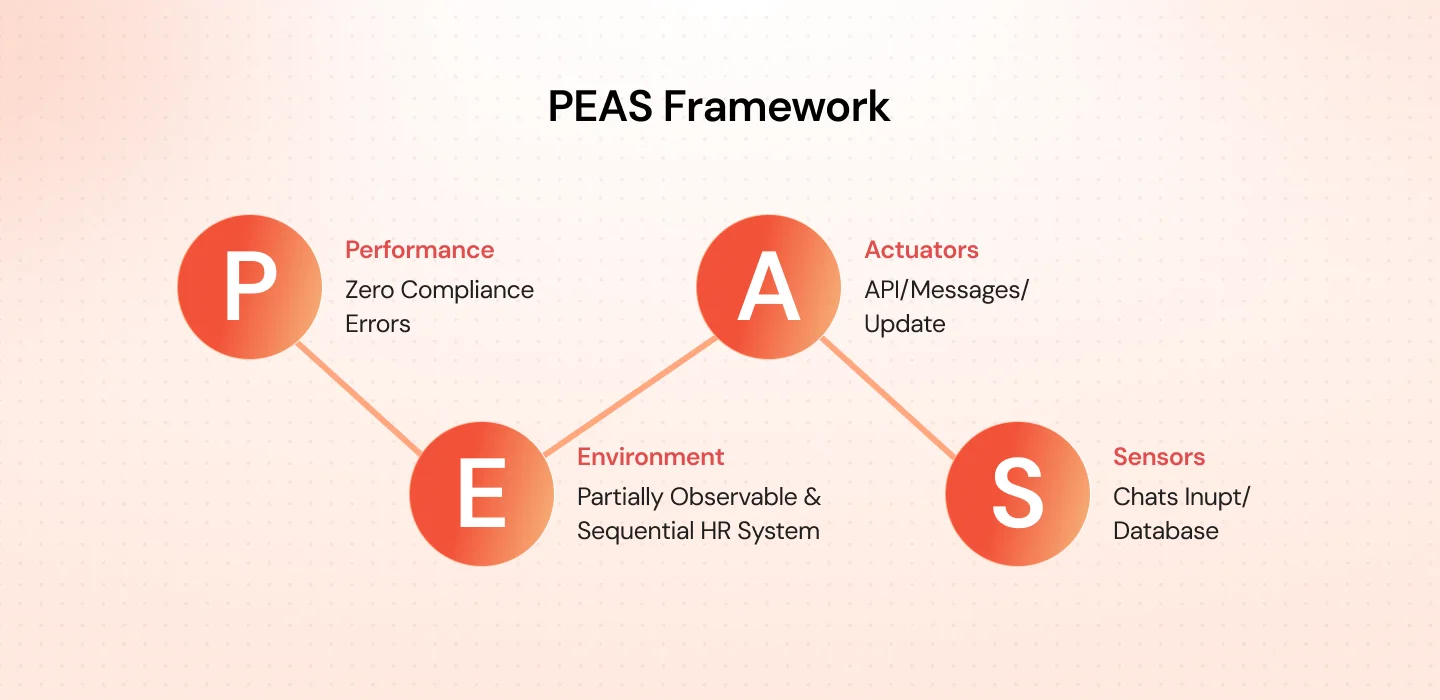
PEAS (Performance, Environment, Actuators, Sensors) is the standard framework for specifying an agent’s role before building it. Applying this to a BlazeUp HR agent reveals a clear structural map of artificial intelligence agents and environments:
- Performance: Resolved employee queries + zero compliance errors.
- Environment: Partially observable, sequential, and stochastic.
- Actuators: Send message, update record, route approval, or escalate to human.
- Sensors: Employee chat input, HR database, and policy documents.
- Expert Perspective: Before deploying any agent, run it through PEAS. It forces you to scope the problem accurately before wasting budget on the wrong architecture.
Multi-Agent Environments — When One Agent Is Not Enough
In highly complex scenarios, a multi agent environment in AI is employed. Here, multiple specialized agents coordinate to solve a problem. For example, one agent might retrieve data from a CRM, another analyzes the sentiment of a customer complaint, and a third executes a refund.
Enterprises cannot afford “uncontrolled cognition.” They need reproducibility and governance. In a multi agent environment in AI, director agents manage specialized “agent pods.” BlazeUp’s platform connects Core HR, Finance, IT, and CRM agents in a shared environment, allowing them to specialize in their domains while sharing data through a unified orchestration layer.
How to Choose the Right Architecture for Your Environment
When ready to buy or build, ask these 4 questions:
1. Is the environment a partially observable environment in AI?
If Yes: Your agent must include a persistent memory module (such as a vector database or a temporal knowledge graph). Because the agent cannot see your entire operational data landscape at once—such as looking at an isolated support ticket without the employee’s historical legacy context—it requires a mechanism to retain, update, and recall long-term states across separate sessions.
Balancing the Architecture: When a workflow operates within a fully observable environment in AI, these memory constraints shift significantly. If the agent has immediate, guaranteed access to 100% of the relevant data needed for a decision right inside the current input frame (like reading a standalone invoice document), you can comfortably utilize a lightweight, stateless architecture. This allows you to streamline processing and entirely bypass the cost and computing overhead of external memory storage.
2. Are tasks sequential?
If Yes: The system requires an explicit planning layer and episodic tracking capabilities. Because its current actions permanently alter future system states (such as an entry error on an onboarding form directly corrupting payroll and tax compliance logs months down the road), the agent must have the capacity to map out multi-step chains of thought and anticipate downstream consequences before executing a command.
Balancing the Architecture: In contrast, simpler operations belong in an episodic environment in AI. If a choice has zero structural impact on future inputs (such as processing individual, unrelated customer reviews for sentiment analysis), you can choose a fast execution design that skips the overhead of long-term tracking mechanisms, allowing the system to reset completely after each task.
3. Does the workflow require real-time execution or strategic planning?
If Strategic Planning: Complex corporate processes that involve hidden variables and trade-offs require a deliberative or goal-based model. The agent needs time to simulate paths and verify rules against company policy databases before taking a step.
Balancing the Architecture: Conversely, predictable, fast, and rule-bound tasks can rely purely on a reflex agent in AI. If your system only needs to flag emails based on certain keywords or trigger basic notifications, a simple reactive script delivers the highest speed at the lowest cost. For mixed enterprise requirements, a hybrid model is necessary.
4. Is cross-department coordination required?
If Yes: Moving data and automating processes across distinct business silos cannot be solved by a lone bot. It demands a multi agent environment in AI governed by an orchestration layer. This setup ensures different specialized entities can pass context, delegate subtasks, and coordinate execution pathways without causing data collisions or logic errors.
Balancing the Architecture: When a process is fully self-contained within a single silo (such as a local script formatting data within an isolated spreadsheet), you can deploy a single-agent architecture. This keeps the technical stack simple and saves you from setting up complex communication protocols.
For an HR or operations team, the answer is almost always a partially observable, sequential, hybrid architecture within a multi-agent environment. This is exactly what Blazeup is built for.
Conclusion
Architecture defines how an agent thinks, while the environment defines where it operates. Getting both right is what separates agents that scale from those that stall. The most common enterprise failure is deploying a simple reflex agent in AI into a sequential, partially observable business environment.
For a COO or HR manager, you don’t need to build the architecture yourself. You need to choose a platform that has built it correctly for your environment. Ready to deploy agents built for the real world? Explore how the Blazeup platform masters artificial intelligence agents and environments through specialized, hybrid design.
 Jamie Ho