

Finance Agent
The Ultimate Finance Automation Strategy for Scalable Global Growth
- 14 May, 2026
- Max 10 min read
 Ami Tran
Table of Content
Expanding into new markets is easier today than it was even a few years ago. Digital infrastructure, cross-border payment systems, and global hiring platforms have lowered many of the traditional barriers to growth. From a commercial perspective, scaling internationally has become faster and more achievable.
Finance, however, often absorbs the complexity that comes with that expansion. Each new entity introduces additional currencies, regulatory requirements, tax rules, and reporting obligations. What once worked well for a single market begins to strain under multi-country operations. Many organizations respond by adding tools or hiring more staff. That can ease the pressure temporarily, but it does not address the structural problem. Disconnected automation may speed up individual tasks, yet the coordination between systems remains manual.
A sustainable finance automation strategy requires more than digitizing existing steps. It requires rethinking how workflows operate across markets and systems so they can scale without multiplying manual effort. In this article, we look at why manual finance models struggle under growth, what separates true automation from tactical fixes, and how intelligent automation is reshaping global finance operations.
The Global Growth Wall: Why Manual Finance Can’t Scale
Manual finance processes work fine when your business is small and local. A few spreadsheets handle reconciliation. Email chains manage approvals. One finance team tracks expenses, payroll, and reporting from a single location.
When you expand internationally, you’re dealing with multiple currencies, different tax systems, and varying compliance requirements across countries. Those same manual processes that worked perfectly now create chaos. Approvals get lost across time zones. Spreadsheets become error-prone nightmares. Month-end close takes weeks instead of days.
Below are 3 factors that cause this collapse:
1. Too Many Transactions to Handle Manually
Every new market you enter brings more invoices, more approvals, and more exceptions to manage. Manual processes that worked fine locally start breaking down: approvals get stuck waiting for someone in a different time zone, data sits in multiple systems that don’t connect, and simple tasks that took hours now take days.
The problem isn’t your team’s effort; it’s that manual coordination can’t scale. As transaction volume grows, your finance team spends more time chasing approvals and reconciling errors than analyzing performance.
Consider: Automated financial workflows route work automatically across systems and time zones, eliminating manual handoffs so your team can focus on strategic work instead of administrative tasks.
2. Financial Data Is Always Out of Date
When you’re operating globally, you need to know your cash position and spending right now, not last week. But manual processes create constant lag. Transactions sit unrecorded for days. Reconciliation happens long after the fact. By the time reports are ready, they show old numbers that no longer reflect your actual financial position.
This forces leadership to make critical decisions based on outdated snapshots or rough estimates. The bigger you grow, the wider this information gap becomes.
Consider: Real-time cash flow visibility gives you an accurate, up-to-the-minute view of your financial position across all markets, enabling faster and more confident decision-making.
3. Different Teams Follow Different Rules
Manual approval processes seem like solid governance, but they break down across locations. One manager interprets spending policies strictly, another takes a looser approach. Some regions document everything in email, others use spreadsheets. When errors or exceptions occur, tracing what happened and who approved it becomes a detective investigation.
This inconsistency creates serious problems as you expand. You can’t demonstrate clear controls to auditors, regional differences expose you to regulatory violations, and what looks like careful oversight is actually a compliance risk.
Consider: Standardized compliance controls built into your finance systems ensure consistent policy enforcement across all regions, creating clear audit trails and reducing regulatory risk automatically.
Building a Modern Finance Automation Strategy
A modern finance automation strategy is not about replacing people with software. It is about redesigning how financial workflows work so routine tasks run consistently, data stays accurate, and teams can scale without adding operational friction.
Instead of automating tasks in isolation, leading organizations focus on end-to-end workflows. Each process is designed to reduce manual intervention, standardize decision logic, and ensure financial data moves cleanly from execution to reporting.
How Finance Automation Is Designed
Rather than viewing finance automation as a collection of standalone features, it is easier to understand it as a connected system. Each part works together to move financial work forward smoothly, with less manual effort at every step.
From a workflow perspective, this means finance automation is designed to manage processes from start to finish. Instead of optimizing individual tasks in isolation, it ensures that data, approvals, and decisions flow continuously across the entire finance process.
1. Workflow design principles
At its core, finance automation defines how financial work should flow across the organization, forming the foundation of automated financial workflows. The goal is to make processes predictable and efficient by reducing manual coordination and handling decisions as early as possible.
In practice, this means finance automation is designed to:
- Align data across systems at the source through ERP integration, so information from ERP, banking, payroll, and expense tools stays consistent without repeated checks later.
- Remove manual handoffs, replacing paper forms, emails, and spreadsheets with structured digital workflows.
- Apply business rules upfront, allowing transactions to be validated, categorized, and routed correctly before errors spread downstream.
- Maintain continuously updated records to improve cash flow visibility, ensuring balances, transactions, and ledgers reflect real business activity rather than delayed updates.
- Limit human involvement to exceptions, reducing operational bottlenecks, so finance teams focus on unusual cases, policy breaches, or high‑impact discrepancies instead of routine work.
2. Enabling automation capabilities
These workflow principles are supported by a modern financial tech stack that works together behind the scenes. Each capability plays a specific role in moving data, applying logic, and keeping processes running reliably.
Key enabling capabilities include:
- Data capture and digitization, which converts invoices, receipts, and forms into structured financial data.
- Robotic Process Automation (RPA) engines are responsible for executing routine actions such as approvals, postings, reconciliations, and payment processing.
- Intelligence layers, which analyze historical patterns to improve accuracy, detect anomalies, and highlight potential risks.
- Cloud-based foundations provide secure, real-time access to financial information across teams and locations.
- System integrations that support multi-currency reconciliation, allowing finance applications to exchange data automatically without manual re-entry.
How Finance Automation Works in Practice
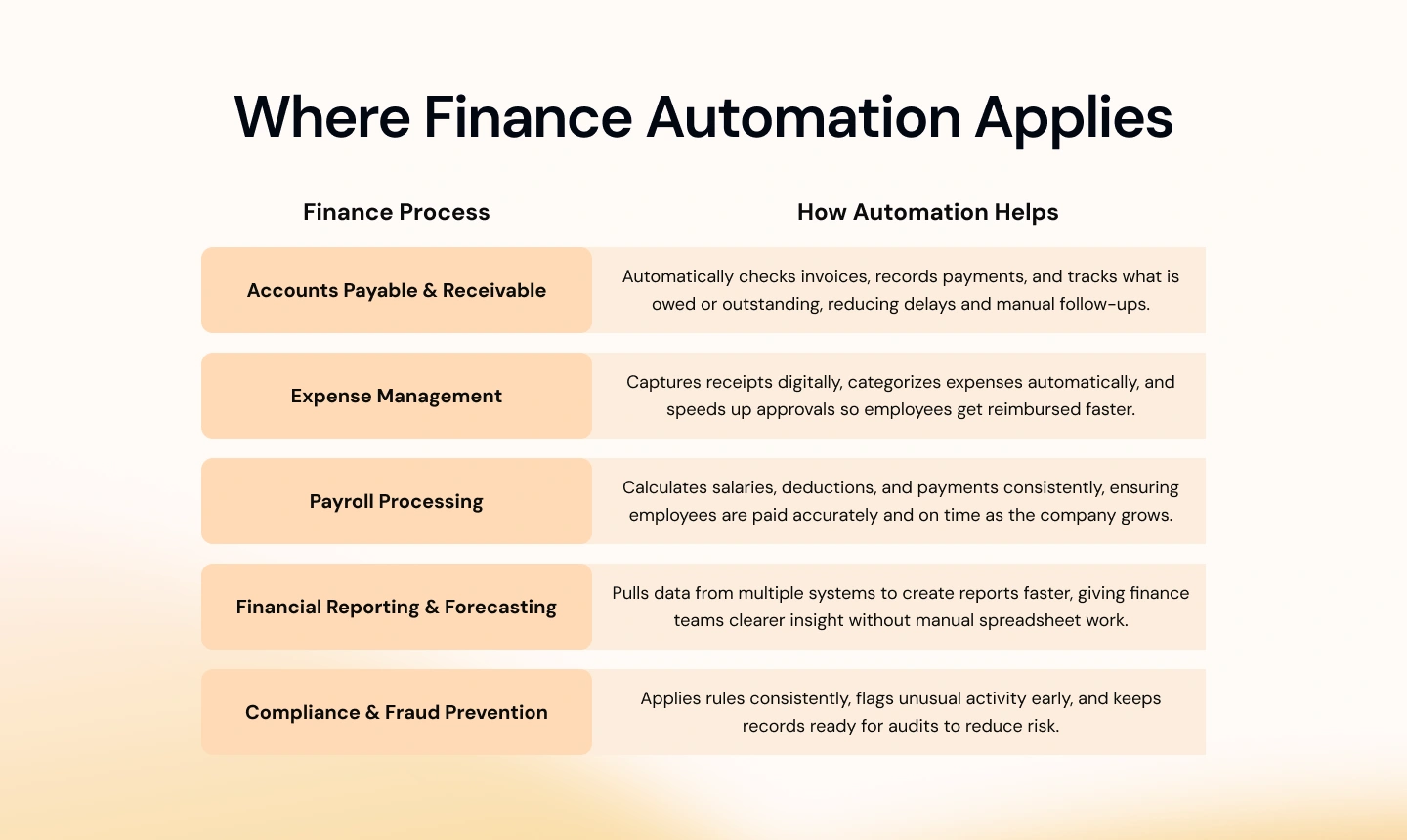
In most companies, finance automation does not begin with a large transformation plan. It begins with frustration. Teams notice the same steps repeating every week, entering invoices, approving expenses, recalculating payroll adjustments, and preparing recurring reports.
These tasks are not complicated, but they take time and leave room for small errors. Automation takes over those predictable steps. An invoice is matched automatically instead of reviewed line by line. An expense is checked against policy before it reaches a manager. Payroll follows predefined rules without manual recalculation each cycle.
This is where digital finance transformation becomes practical rather than theoretical. The goal is not to remove oversight. It is to reduce unnecessary handling. Routine work runs in the background, while finance focuses on review, analysis, and decisions. As the business grows, the process does not become heavier because execution no longer depends on constant manual coordination.
The Future of Finance: Scaling with Blazeup’s AI Agent
As global operations become more complex, the future of finance depends on moving beyond task-based automation toward systems that can manage work end to end. Scaling finance is no longer just about handling higher volumes. It is about reducing coordination, maintaining control, and delivering timely insight without increasing headcount or operational risk.
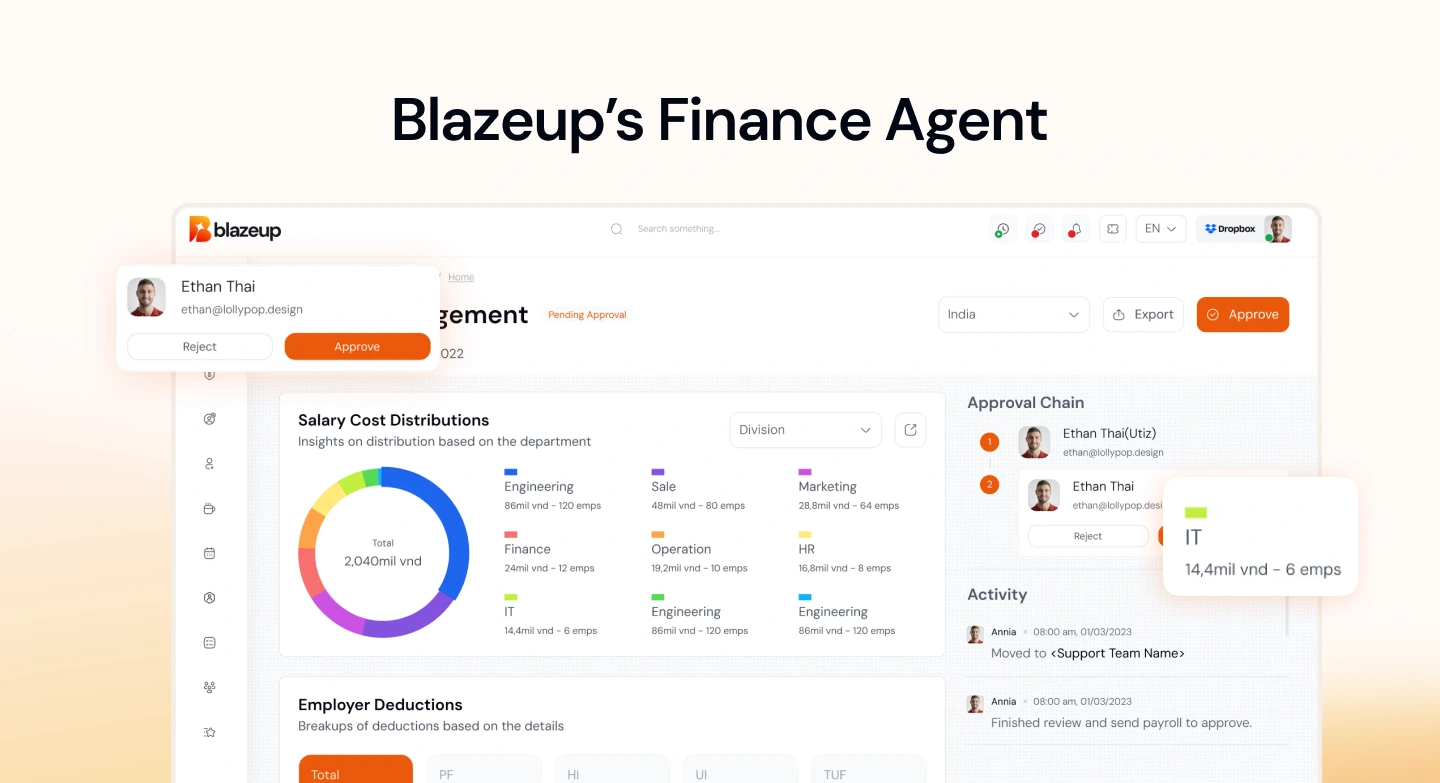
This is where Blazeup’s AI finance agent changes how finance operates. Built directly into the Blazeup platform, the agent manages automated financial workflows from within a single system, monitoring execution and handling routine decisions based on defined rules. By taking ownership of continuous execution inside Blazeup, the AI agent helps finance teams avoid bottlenecks that typically emerge as organizations grow.
With Blazeup’s AI Agent supporting finance automation, organizations can scale with confidence. Routine validations, reconciliations, and approvals run continuously in the background, while finance teams focus on exceptions, analysis, and strategic decision-making. This shift enables more autonomous finance operations, allowing finance to support global growth without sacrificing accuracy, visibility, or governance.
Final Thoughts
As companies expand into new markets, finance often feels the pressure first. Processes that were manageable at a smaller scale can become strained as transaction volume grows and regulatory requirements multiply. Manual coordination and disconnected tools may still function, but they require increasing effort to maintain.
Sustainable scale usually depends on how workflows are structured, not how many systems are added. A clear finance automation strategy, supported by an embedded AI finance agent, allows routine execution to run without constant supervision. That shift gives finance teams more space to focus on oversight, analysis, and business support rather than operational maintenance.
If you are evaluating how well your current processes will hold up under continued growth, it may be worth reviewing where coordination still slows execution. Blazeup’s AI finance agent is designed to support that transition by helping teams streamline routine work while maintaining control.
Frequently Asked Questions (FAQs)
Finance automation is the use of technology to run routine financial processes with minimal manual effort. It replaces spreadsheets, emails, and manual checks with structured workflows that handle tasks like data capture, validation, approvals, reconciliation, and reporting consistently, helping finance teams reduce errors, improve visibility, and focus on higher-value analysis.

 Jamie Ho
 Sathvik Bellave