Core HR Agent
The Future of Talent Management: What It Is and How AI Is Transforming It
- 26 October, 2026
- 10 Minutes
 Jamie Ho
Table of Content
Hiring the right people is only the first step in building a strong workforce. Organizations also need to help employees develop their skills, improve their performance, and find opportunities to grow within the business.
Without ongoing feedback, recognition, and development opportunities, even talented employees may struggle to reach their full potential. Talent management helps organizations address these challenges by supporting employees throughout their time with the business.
In recent years, these challenges are becoming more complex as skill requirements change and organizations compete to attract and retain talent. AI offers new ways to support talent management, from identifying skill gaps and recommending learning opportunities to assisting with performance reviews and internal mobility.
This guide explains what talent management means, how AI can support each stage of the employee lifecycle, and how organizations can introduce AI into their HR processes. It also outlines practical strategies for helping employees develop their skills and prepare for changing business needs.
Key takeaways
- Talent management covers the entire employee lifecycle, including hiring, onboarding, daily development, retention, and leadership planning.
- Skills-based insights help HR teams identify development needs and match employees with suitable learning and internal career opportunities.
- AI can reduce repetitive HR work and help teams use workforce data to support more informed decisions.
- Human oversight remains essential to protect employee data, review AI recommendations, and monitor potential bias.
- A step-by-step approach helps manage implementation risks safely without disrupting daily operations.
What Is Talent Management — and Why It Matters Beyond HR
Talent management is the process of attracting, developing, engaging, and retaining employees to meet business goals. It covers the employee lifecycle, from workforce planning and recruitment to onboarding, performance management, learning and development, and succession planning.
For business leaders, talent management connects workforce capabilities with business priorities. By identifying the skills the business needs, supporting employee development, and preparing people for future roles, organizations can respond more effectively to changing demands and maintain operational continuity.
Why is talent management a business-critical function?
Talent management helps organizations address workforce challenges that can affect performance and long-term growth. It gives HR teams and managers a structured way to develop employees, strengthen engagement, and prepare for future staffing needs. Talent management helps organizations address these priorities in 4 key ways.
- Bridge skills gaps: Equip employees with the skills needed to meet current and future business demands.
- Strengthen performance: Set clear expectations and provide regular feedback to help employees work toward business goals.
- Improve employee engagement: Offer learning and career development opportunities that motivate employees to grow.
- Support retention: Help employees see long-term opportunities within the organization, reducing turnover and preserving valuable knowledge.
Gallup’s research found that business units in the top quartile of employee engagement achieved 23% higher profitability than those in the bottom quartile. This finding highlights an association between employee engagement and business performance, although it does not prove that talent management alone causes higher profitability.
The talent management process: 5 stages across the employee lifecycle
Talent management covers the processes businesses use to attract, develop, and retain employees while preparing for future workforce needs. These activities are connected: hiring brings people into the organization, onboarding helps them get started, and ongoing development helps them improve their performance and prepare for new responsibilities.
A structured talent management process helps HR teams and business leaders coordinate these activities, identify workforce gaps, and prepare for employee transitions. The exact process varies by organization, but five key stages provide a practical framework for understanding how talent management works.
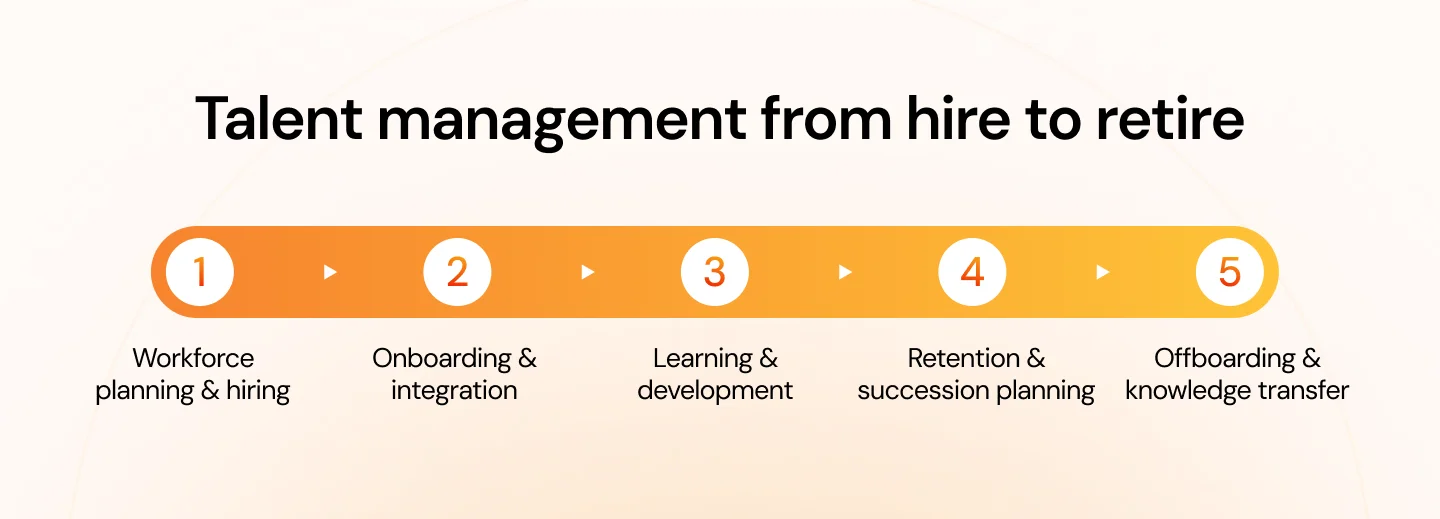
1. Workforce planning and hiring
Workforce planning helps businesses identify the roles and skills they need to meet current goals and prepare for future demands. HR teams work with business leaders to assess staffing needs, identify skills gaps, and define job requirements before recruitment begins.
Recruiters can then source and evaluate candidates based on relevant skills, experience, and qualifications. This helps organizations find people whose capabilities align with the role and the business’s longer-term needs.
Best practices to consider: Review workforce needs against business goals and upcoming projects before opening new positions. Define the essential skills and qualifications for each role, and use consistent, job-related criteria to evaluate candidates. Consider internal candidates alongside external applicants when existing employees may be ready to take on new responsibilities.
2. Onboarding and integration
Onboarding helps new employees understand their responsibilities, access the tools they need, and build relationships with colleagues. Clear expectations and regular communication help new hires settle into their roles and understand how their work contributes to the team.
A structured onboarding process also gives managers opportunities to identify early challenges and provide support before these affect an employee’s performance or engagement.
Best practices to consider: Prepare a clear onboarding plan before each employee’s first day, covering role expectations, essential tools, company policies, and key contacts. Set milestones for the first 30, 60, and 90 days, where appropriate, and schedule regular check-ins with the manager. Gather feedback from new hires to identify gaps in the onboarding process.
3. Performance management and development
Performance management helps organizations set expectations, review employee progress, and identify areas for improvement. Regular feedback gives employees a clearer understanding of their strengths, the skills they need to develop, and how their work contributes to business goals.
Learning and development builds on these discussions by connecting identified skill gaps with relevant training, coaching, and career opportunities. Reviewing progress after training helps managers understand whether employees are applying new skills effectively.
Best practices to consider: Set clear, measurable goals that connect individual responsibilities with business priorities. Provide feedback throughout the year rather than relying solely on annual reviews. Use performance discussions to identify specific development needs, agree on learning goals, and follow up to assess progress.
4. Retention and succession planning
Retention focuses on creating conditions that encourage employees to stay and grow within the organization. Career development, supportive management, recognition, and appropriate compensation can all influence employees’ decisions to remain with a company.
Succession planning addresses a related but different need: preparing employees to take on critical roles when experienced staff leave, retire, or move into new positions. This involves identifying key roles, developing potential successors, and transferring the knowledge required to maintain business continuity.
Best practices to consider: Use employee feedback, exit interview trends, and retention data to identify recurring reasons people leave. Make career paths and development opportunities visible to employees. For succession planning, identify roles that are critical to business continuity, assess potential successors against clear criteria, and provide development opportunities to prepare them for greater responsibilities.
5. Offboarding and knowledge transfer
Offboarding manages the administrative, operational, and security tasks involved when an employee leaves the organization. HR and managers coordinate final documentation, the return of company equipment, the transfer of responsibilities, and the completion of any required exit procedures. IT teams must also ensure that access to company systems is revoked at the appropriate time.
Knowledge transfer is particularly important when departing employees manage projects, maintain client relationships, or hold specialized knowledge. Documenting ongoing work and assigning clear ownership helps reduce disruption after their departure.
Exit interviews can provide additional insight into why employees leave. By reviewing feedback across multiple departures, HR teams may identify recurring concerns related to workload, management, compensation, or career development.
Best practices to consider: Start the handover process early enough to document ongoing projects, key contacts, outstanding tasks, and important procedures. Assign a clear owner to each responsibility being transferred. Coordinate the return of company assets and the timely revocation of system access with the relevant teams. Review exit feedback for recurring issues that may require changes to management practices or employee development.
AI in Talent Management — How It Changes Every Stage of the Lifecycle
Artificial intelligence is transforming how modern HR teams manage their workforce across every lifecycle stage. Rather than replacing human decision-making, AI automates repetitive tasks and delivers real-time data insights to help HR leaders act faster.
Integrating machine learning directly into daily operations modernizes the entire employee journey. The breakdown below demonstrates how artificial intelligence enhances each of the 5 core talent management stages:

1. AI-assisted candidate sourcing
AI analyzes historical recruitment data and labor market trends to identify potential candidates with relevant skills and experience. It searches available candidate profiles to find qualified professionals, including passive candidates who may not be actively looking for a new job.
Beyond sourcing candidates for current vacancies, AI can also analyze business growth plans and employee turnover patterns to anticipate future hiring needs. This helps HR teams build talent pipelines in advance, so they are better prepared when new positions open.
2. Automated onboarding workflows
Intelligent digital assistants handle administrative onboarding tasks automatically from the moment a candidate signs their offer letter. AI systems collect compliance documents, trigger IT equipment requests, and answer common new-hire questions around the clock.
By personalizing orientation schedules based on role and department, AI helps new hires acclimate without manual HR oversight. This seamless integration speeds up time-to-productivity and removes administrative friction during the critical first 90 days.
3. Personalized skill gap analysis
Machine learning platforms continuously evaluate daily work outputs, project deliverables, and manager feedback to spot emerging skill deficiencies. Rather than relying on annual training requests, AI automatically maps individual performance against required role capabilities.
When skill gaps appear, the system delivers customized micro-learning recommendations directly to the employee’s workspace. This real-time developmental support ensures employees build relevant skills that match immediate business needs.
4. Attrition risk forecasting
AI analyzes workforce data, including engagement survey results, performance trends, employee turnover patterns, and compensation benchmarks, to identify signs of potential retention risks. These insights help HR teams spot issues such as declining engagement or limited career opportunities before they lead to more employee departures.
With a clearer view of these risks, HR leaders can investigate the underlying causes and take targeted action, such as improving career development opportunities, reviewing compensation, or providing additional manager support. Addressing these issues early helps retain valuable employees and preserve important knowledge within the organization.
5. Data-driven succession scoring
AI analyzes employee skills, performance, and project experience to help HR identify potential successors for leadership roles and the development they need to prepare. HR teams can use these insights to plan employee development and maintain leadership continuity when key positions become vacant.
With AI supporting talent management, organizations can improve how they develop and prepare their workforce for future needs. The following examples show how companies apply technology to recruitment, employee development, and internal mobility.
Ready to streamline HR operations? Explore how Blazeup uses AI agents to connect and automate workflows across recruitment, onboarding, performance management, and more.
AI Talent Management in Practice — Real Companies, Real Numbers
Global enterprises are moving beyond AI experimentation to achieve measurable operational ROI across their HR workflows. Leading companies use artificial intelligence to automate routine administration, reduce turnover, and accelerate internal mobility at scale.
Real-world implementation metrics highlight how data-driven HR processes improve organizational efficiency. The detailed case studies below illustrate the concrete business outcomes of modern AI talent platforms:
1. Walmart – AI-powered interview coaching and internal talent matching
Walmart has introduced AI-powered tools such as an interview coach to help candidates practice interview questions and receive feedback on their responses. The company has also explored tools that match employees’ skills with job opportunities, supporting career development and internal mobility.
The broader lesson is AI can help employees prepare for new roles and identify career opportunities that align with their existing skills. Employers still need to ensure that these tools provide relevant guidance and that hiring and promotion decisions remain appropriately evaluated by people.
2. L’Oréal – AI-assisted recruitment and inclusive hiring
L’Oréal incorporates AI into parts of its recruitment process, using tools to streamline interview scheduling and support improvements in job descriptions. The company also sets guidelines for AI-assisted interviews, emphasizing candidate consent and human involvement in recruitment decisions.
This approach highlights the importance of using AI responsibly throughout recruitment. Clear guidelines on data privacy, candidate consent, and human oversight help ensure that AI supports hiring teams without compromising fairness or trust.
3. Nestlé – AI-powered employee learning and knowledge access
Nestlé is expanding AI adoption across its workforce, with more than 100,000 employees using AI regularly. In finance, AI helps teams clean data, generate reports, analyze performance, and improve forecasts, reducing manual work and speeding up access to business insights.
This demonstrates how AI can help employees handle routine tasks more efficiently and dedicate more time to analysis and decision-making. Training employees to use AI tools effectively is essential to turning adoption into meaningful productivity gains.
How to Implement AI Talent Management: A Practical Roadmap for HR Teams
Adopting AI for talent management does not require changing every HR process at once. HR teams can start by identifying time-consuming tasks, testing suitable tools, and expanding their use based on measurable results.
The following 5-step roadmap helps organizations introduce AI while managing implementation effort, employee adoption, and data privacy.
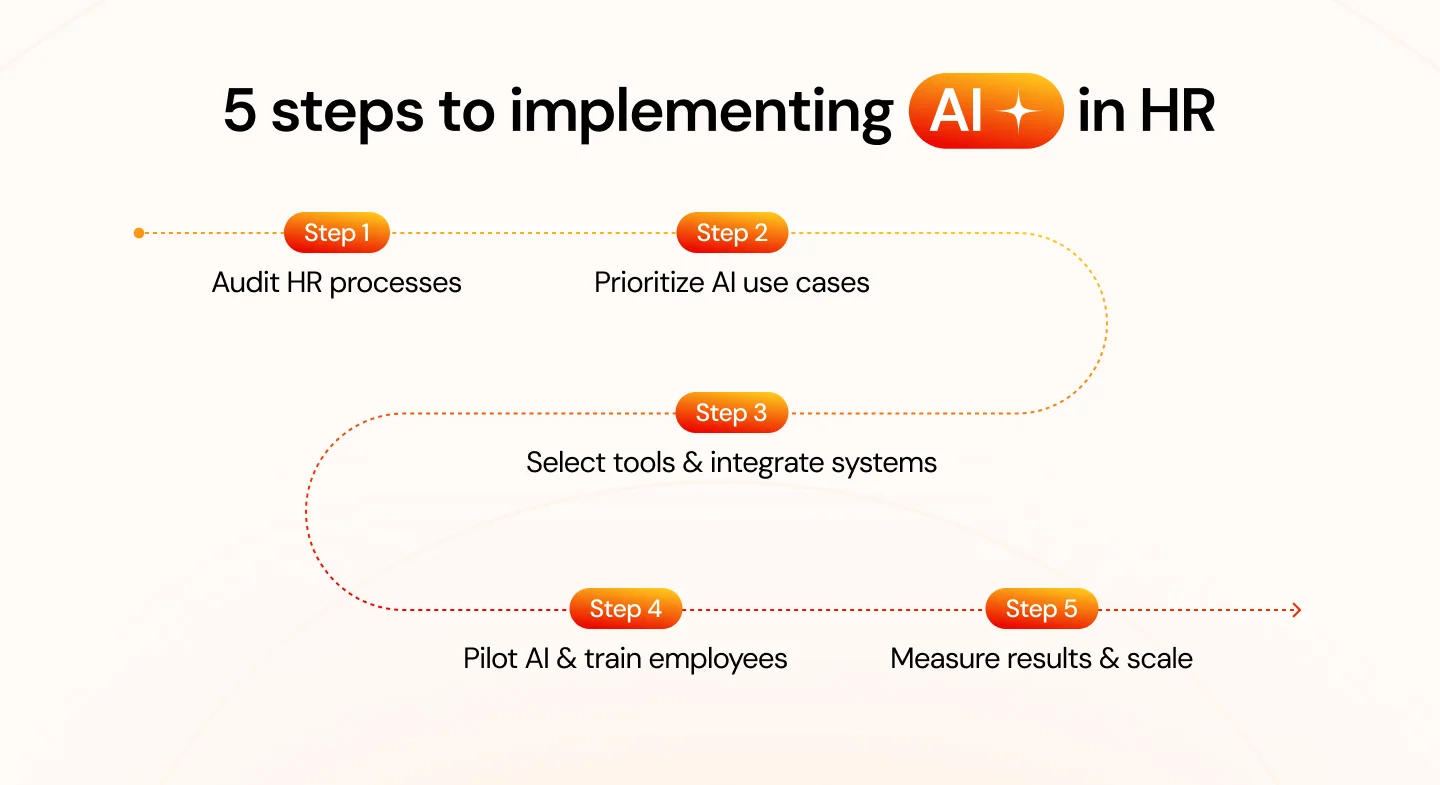
Step 1: Audit HR processes
Start by reviewing the tools and workflows used for recruitment, onboarding, performance management, employee training, and career development. Identify duplicated work, disconnected employee data, and tasks that require frequent manual follow-ups.
For example: An HR team uses separate systems to track recruitment, training, and performance reviews. Reviewing these workflows helps identify where information is difficult to access and where AI could reduce repetitive work.
Step 2: Prioritize AI use cases
Choose 2 or 3 tasks where AI could make a practical difference, such as reducing the time spent reviewing internal applications or coordinating employee development. Assess each task based on its expected business value, the availability of reliable data, and how easily it can fit into existing HR processes.
At the same time, establish guidelines for employee data access, privacy, and responsible AI use. HR teams should explain how AI supports employment-related decisions, check for potential bias, and keep people involved in important decisions about training, promotions, and career opportunities.
For example: A company struggles to identify suitable employees for internal vacancies and coordinate training. HR begins by testing AI-supported skills matching and personalized learning recommendations, while defining how employee data can be accessed and how recommendations will be reviewed.
Step 3: Select tools & integrate systems
Choose AI solutions that fit current HR processes and can work with the systems the organization already uses. Evaluate integration capabilities, data security, scalability, reporting, and whether the platform supports multiple stages of talent management rather than only one isolated task.
For example: A mid-sized business wants to connect recruitment, onboarding, and employee development without replacing its entire HR system. Before selecting a platform, the HR team checks its compatibility with existing HR and payroll tools and how employee information will be shared between systems.
Step 4: Pilot AI & train employees
Test the selected use cases with a clearly defined team or process before expanding across the organization. Provide practical training so HR staff and managers understand how to use AI tools, review recommendations, and identify errors or potential bias.
For example: An HR team pilots AI-assisted skills matching in one department for 30 days. The team compares the time needed to identify suitable internal candidates before and after the pilot, reviews recommendation accuracy, and gathers feedback from users before deciding whether to expand the programme.
Step 5: Measure results & scale
Define success metrics before the pilot, such as time saved, recommendation accuracy, employee feedback, and internal mobility. If the results meet expectations, expand the solution to other teams while continuing to monitor performance and improve workflows.
For example: After a successful skills-matching pilot, the company expands the tool to another department. HR continues to review recommendation accuracy, employee feedback, and internal mobility outcomes to determine whether the wider rollout is delivering the expected value.
Talent Management Strategy: What Leading Companies Do Differently
An effective talent management strategy goes beyond hiring. Businesses also need to develop employee skills, support career growth, and retain valuable people as workforce needs change. The following practices show how organizations can build a workforce that is ready for future business needs.
1. Build a skills-based workforce
Skills-based talent management focuses on what employees can do and how their skills can be applied across different roles, rather than relying only on job titles or degrees. By mapping employees’ existing skills against business needs, companies can identify capability gaps, uncover transferable skills, and find internal candidates for roles that might otherwise require external hiring.
For example: A company struggles to find qualified external candidates for a project management role, so HR explores whether existing employees have the skills and experience needed to take on the position.
- Identify the need: Determine the skills and experience required for the project management role.
- Review existing talent: Assess employees’ current skills and experience to find potential candidates.
- Match relevant skills: Identify employees with transferable skills in coordination, communication, and planning.
- Develop internal talent: Provide additional training to help suitable employees prepare for the role.
2. Make learning part of the work culture
Employee development works best when learning is an ongoing process rather than a one-time training activity. Businesses can support continuous learning through mentoring, practical training, and structured development programmes that help employees build skills as business needs evolve.
For example: A company introduces regular skills training and mentoring sessions for employees in its sales team. Managers use performance discussions to identify development needs and recommend learning activities that help employees prepare for more advanced responsibilities.
3. Support career growth and internal mobility
Employees need opportunities to develop their careers within an organization. Internal mobility programmes help them explore new roles, build relevant skills, and move into positions that match their strengths and career goals. AI tools can further support this process by matching employee skills with available roles and identifying areas for development.
For example: An employee in customer support wants to move into a business analyst role. HR reviews the employee’s existing skills against the role requirements, identifies gaps in data analysis, and recommends relevant training before the employee applies for the internal position.
4. Combine flexibility with clear growth opportunities
Flexible work arrangements can help employees balance work and personal responsibilities, while clear development paths give them opportunities to progress within the organization. Businesses can support both through regular career conversations, mentoring, and access to relevant learning opportunities.
For example: A company offers flexible working arrangements alongside individual development plans. Employees can discuss career goals with their managers, access relevant training, and explore internal opportunities while maintaining working arrangements that meet both personal and business needs.
5. Use workforce data for succession planning
Succession planning helps businesses prepare employees to take on critical roles when responsibilities change or key employees leave. HR teams can use performance information, skills data, and development plans to identify potential successors and determine where further training is needed.
For example: A department manager plans to retire within the next year. HR works with business leaders to identify potential successors, assess their readiness, and create mentoring and development plans to prepare them for the transition.
Conclusion
Talent management is more than hiring and retaining employees. It requires a connected approach to workforce planning, employee development, performance management, and succession planning to help businesses prepare for changing workforce needs.
AI can support these efforts by identifying skills gaps, recommending learning opportunities, and reducing repetitive HR tasks. However, successful adoption still depends on clear goals, reliable data, and human oversight. HR teams should start with a few practical use cases, measure the results, and expand AI where it delivers real value.
For businesses looking to simplify HR workflows, Blazeup offers AI agents that can support everyday HR operations and work with existing systems. Explore Blazeup to see how AI agents may fit into your organization’s talent management processes.