

Core HR Agent
AI in Recruitment: How It Works & The Hiring Process
- 15 October, 2026
- 10 Minutes
 Jamie Ho
Table of Content
What if AI could handle the repetitive work behind every hire?
Recruitment involves more than reviewing applications, as recruiters must also shortlist candidates, schedule interviews, answer questions, and keep applicants informed throughout the hiring process. These tasks can stretch hiring timelines, especially for small HR teams managing multiple vacancies.
Using AI for recruitment will support teams handling repetitive tasks more efficiently, reducing administrative work. Recruiters have more time to evaluate candidate suitability, build relationships with applicants, and make informed hiring decisions.
This article explores how AI supports recruitment tasks, from preparing job descriptions and screening CVs to scheduling interviews and coordinating onboarding. It also explores how AI recruitment tools help HR teams reduce manual work and manage hiring more efficiently.
Key takeaways
- AI helps recruiters screen CVs and identify applicants who meet the role’s requirements.
- By handling routine hiring tasks, AI gives recruiters more time to engage with candidates and assess their suitability.
- AI expands candidate searches by finding relevant skills and experience beyond exact job title or keyword matches.
- Human oversight remains essential to check AI recommendations, reduce potential bias, and make fair hiring decisions.
- Starting with one use case helps HR teams evaluate the results before expanding AI to other recruitment tasks.
What Is AI in Recruitment?
AI in recruitment uses artificial intelligence to support hiring tasks such as candidate sourcing, screening, and interview scheduling. Unlike traditional applicant tracking systems (ATS) that may rely heavily on keyword matching, some AI tools can analyze skills, experience, and context to help recruiters identify relevant candidates.
For example: A job requires data visualization skills. An AI recruitment tool may identify a candidate who has used Tableau or Power BI, even if their resume does not explicitly mention “data visualization.”
By helping recruiters identify relevant candidates and handle routine tasks, AI can reduce manual work during the hiring process. Recruiters can then spend more time assessing candidates, communicating with applicants, and making informed hiring decisions.
Key Stages Where AI Supports Recruitment
The hiring process involves several stages, from preparing job descriptions and screening candidates to scheduling interviews and coordinating onboarding. AI in the hiring process can support routine tasks at each stage, helping recruiters reduce manual work and keep candidates moving forward.
AI supports recruitment across 5 key stages, from drafting job descriptions to coordinating employee onboarding. Here’s how it works at each stage, along with the tools that can help.

1. Job description preparation
AI recruitment tools can turn role requirements into a draft job description, including key responsibilities, required skills, and qualifications. Recruiters can then review the draft, adjust it to match the role, and adapt it for different job platforms.
According to data compiled by Recruiter Copilot from SHRM’s 2025 Talent Trends Survey, 66% of recruiters who use AI use it to write job descriptions, making this the most common AI recruiting task in the survey.
For example: A recruiter provides the job title, key responsibilities, required skills, and qualifications for a marketing specialist. AI uses this information to draft the job description, which the recruiter can refine before publishing.
2. Candidate sourcing and CV screening
For candidate sourcing and screening, AI identifies potential applicants and highlights profiles that match the role’s requirements. Sourcing tools identify people with relevant skills and experience, while screening tools help sort incoming applications so recruiters can focus on candidates who meet the initial criteria.
For example: A company is hiring a marketing specialist with experience in campaign management, analytics, and content strategy. AI can help identify potential candidates with relevant backgrounds and screen submitted resumes for these skills. Recruiters then review the results and decide which candidates should move to the next stage.
3. Interview communication and scheduling
AI recruitment chatbots can answer candidate questions, coordinate interview schedules, and send updates about application progress. Recruiters can use these tools to manage routine communication and spend less time arranging interviews manually.
For example: When a candidate asks about the status of an application, the chatbot can provide the latest available update. If the candidate cannot attend a scheduled interview, the chatbot can check available time slots and help arrange a new one, reducing the need for recruiters to handle each exchange themselves.
4. Skills assessment and evaluation
AI recruitment tools help recruiters evaluate candidates by organizing information from resumes, skills assessments, and interviews. The tools can summarize relevant experience, compare qualifications against job requirements, and flag areas that may need further review, making it easier to assess candidates consistently.
For example: For a marketing role, AI can summarize a candidate’s campaign experience and analytics skills against the job requirements, helping recruiters identify strengths and gaps to explore in a follow-up interview.
5. Hiring and employee onboarding
AI can help HR teams coordinate hiring tasks after selecting a candidate, such as preparing offer documents, collecting the candidate’s response, and organizing onboarding activities once the offer is accepted. By tracking progress across these steps, HR can identify outstanding tasks and follow up with the responsible teams.
For example: When a new hire is due to start in two days, AI tracks whether HR has collected employee information, finance has prepared payroll setup, and IT has arranged a laptop and system access. If any task remains incomplete, HR can follow up with the responsible team before the employee’s first day.
Benefits and Risks of AI in the Hiring Process
AI helps recruitment teams manage tasks such as reviewing applications and communicating with candidates more efficiently. These tools also present risks, including potential bias, data privacy concerns, and over-reliance on automated recommendations. Understanding both sides helps businesses use AI effectively while keeping hiring decisions fair and human-led.
For companies with 100–300 employees, the chatbots can help HR teams manage growing application volumes and reduce time spent on routine recruitment tasks. Its effectiveness depends on the quality of the data, the criteria used to assess candidates, and how recruiters review AI-generated recommendations.

Key Benefits of AI in Recruitment
AI-powered recruiting helps teams screen resumes, match candidates to job requirements, and manage applicant communication more efficiently. By reducing repetitive work, AI gives recruiters more time to assess candidates and make informed hiring decisions, while human oversight helps ensure fair and accurate evaluations.
1. Reduce time-to-hire
Recruiters handling high application volumes often spend hours reviewing CVs, answering candidate questions, and arranging interviews. AI can support these tasks, helping recruiters move applications through the hiring process with less manual coordination.
This gives recruiters more time to evaluate candidates and work with hiring managers. As BCG’s research on AI in recruitment highlights, reducing administrative work gives recruiters more capacity for higher-value activities. The actual time saved depends on the roles being filled and how AI fits into the existing workflow.
2. Improve candidate matching
AI tools can compare candidates’ skills, qualifications, and experience with the requirements of an open position. This helps recruiters identify applicants whose profiles align with the role and consider candidates who might otherwise be overlooked during manual screening.
Skills-based matching can also help recruiters look beyond job titles or traditional career paths. Human review remains essential to assess candidates’ actual capabilities and determine whether they meet the role’s requirements.
3. Expand talent reach
AI can help recruiters search a wider range of candidate profiles and discover qualified people outside their usual sourcing channels. This is particularly useful for specialized roles where suitable candidates may be difficult to find through traditional job postings alone.
According to Boston Consulting Group (BCG), AI can help recruiters discover qualified candidates beyond their usual sourcing channels. By broadening the search, recruiters can consider more potential matches and spend more time engaging with candidates who fit the role.
4. Improve the candidate experience
Recruitment chatbots can answer common questions, provide application updates, and help candidates schedule interviews. Timely responses and clear communication make the hiring process easier to navigate, especially when recruiters are managing many applicants at once.
AI handles routine candidate questions and provides timely application updates, while recruiters remain available to support candidates with more complex questions. This balance helps candidates receive quick responses without losing access to personalized guidance throughout the hiring process.
Key Risks of Using AI in Recruitment
While AI makes recruitment more efficient, it must be used responsibly to ensure these benefits do not come at the expense of fairness or candidate trust. HR teams need to address potential bias, protect candidates’ personal data, and keep human oversight in hiring decisions.
-
Algorithmic bias
AI tools can reproduce or amplify bias in historical hiring data, potentially overlooking qualified candidates or favoring certain profiles over others. This can happen when systems rely on past hiring patterns or criteria unrelated to job requirements.
To reduce this risk, HR teams should use clear, job-related evaluation criteria, test AI outputs across diverse candidate groups, and regularly review hiring outcomes. Human oversight helps recruiters identify biased recommendations and ensure decisions reflect candidates’ relevant skills and qualifications.
-
Candidate concerns about AI
Candidates may hesitate to apply for jobs if they worry that AI will make hiring decisions without human involvement. A 2023 Pew Research Center survey found that 66% of U.S. adults would not want to apply to a company that uses AI to help make hiring decisions.
To address these concerns, companies should explain when and how AI is used, what information it evaluates, and how recruiters review its recommendations. Keeping human recruiters involved in final decisions helps candidates understand that AI supports the process rather than making hiring decisions on its own.
-
Over-reliance on automation
AI can rank candidates based on available data but may miss relevant experience, individual circumstances, or skills that are not clearly reflected in a CV. Relying solely on automated scores can lead recruiters to overlook qualified applicants.
To avoid this, recruiters should use AI recommendations to guide further review, not make final decisions. Applying structured, job-related criteria and assessing candidates individually helps ensure hiring decisions consider the full picture.
-
Legal compliance and data privacy
AI recruitment tools may process sensitive candidate data and influence hiring decisions. Without proper safeguards, companies risk mishandling personal information or failing to meet legal requirements for data protection and fair hiring.
To reduce these risks, HR teams should review applicable regulations before adopting AI tools, verify how vendors collect and store candidate data, and confirm whether requirements such as candidate notifications or bias audits apply to their operations.
4 Steps to Integrate AI into Your Hiring Process
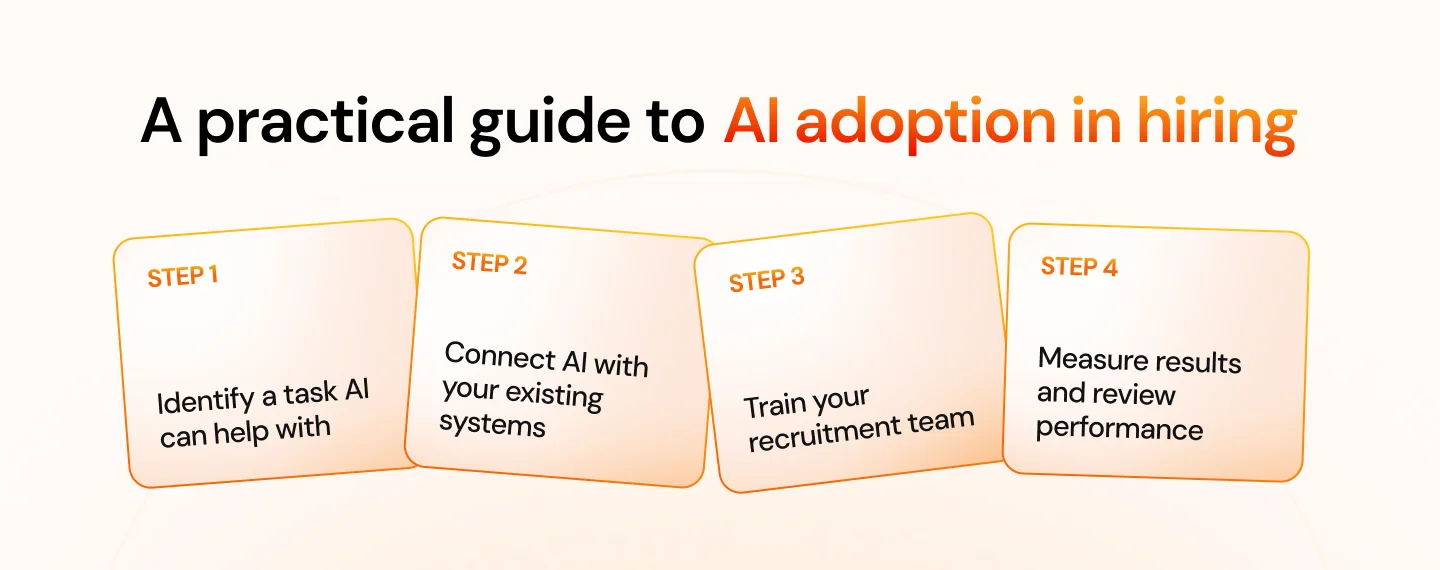
Adopting AI in recruitment does not mean changing your entire hiring process at once. For SMEs with limited HR resources, a practical approach is to start with one task, measure the results, and expand when the benefits are clear. Follow these 4 steps to identify recruitment needs, choose the right AI tools, integrate them into existing workflows, and measure their impact.
Step 1: Identify a task AI can help with
Choose one repetitive recruitment task that takes up significant time, such as preparing job descriptions or scheduling interviews. These tasks are practical starting points because standalone AI tools can often handle them without changing your existing recruitment systems.
AI drafts job descriptions based on role requirements, responsibilities, and required skills, which recruiters can then review and refine before publishing. This allows your team to measure time savings and assess output quality before expanding AI to other recruitment tasks.
Step 2: Connect AI with your existing systems
Once you understand where AI adds value, consider how it can work with your existing recruitment tools. Check whether the solution integrates with your applicant tracking system (ATS) and human resources information system (HRIS), if your company uses them.
A suitable integration can help reduce duplicate data entry and keep candidate information consistent across systems. Before choosing a tool, confirm which integrations it supports, what information it can access, and whether the setup requires additional technical work.
Step 3: Train your recruitment team
To get the most out of AI tools, recruiters need to know how to evaluate and apply their outputs. Training should cover writing clear prompts, reviewing AI-generated content, assessing candidate recommendations, and refining search criteria to find suitable candidates.
Training should also explain what the AI tool can and cannot do, how it uses information, and where human judgment is required. This helps recruiters understand the tool’s role, identify potential errors, and use AI with greater confidence.
Step 4: Measure results and review performance
Define success metrics before introducing AI so your team can compare results with the existing recruitment process. Track the following metrics to evaluate AI’s impact on your recruitment process:
- Time-to-hire: How long it takes to fill a position.
- Cost-per-hire: How much the company spends to recruit each employee.
- Candidate satisfaction: How candidates rate the application and interview process.
- Hiring quality: Whether new hires meet role expectations and perform well over time.
- Fairness and diversity: Whether the process creates unintended disadvantages for particular candidate groups.
Review these metrics regularly to understand where AI is helping and where adjustments are needed. For example, faster CV screening is not a successful outcome if the process also causes qualified candidates to be overlooked.
For a fast-growing company, a practical approach is to start with AI-assisted job descriptions, evaluate the results within 30 days, and then consider expanding to candidate screening or interview scheduling. The 30-day period is a suggested pilot timeline, not a guarantee of return on investment.
Explore Blazeup Core HR Agents to see how AI agents can support everyday HR workflows and reduce manual coordination, giving HR teams more time to focus on people.
Conclusion
AI helps recruitment teams reduce manual work across CV screening, candidate communication, and interview scheduling. By speeding up these tasks, recruiters can spend more time evaluating candidates and making hiring decisions.
For SMEs, the best starting point is to identify the most time-consuming part of recruitment and choose an AI tool that solves that specific problem. Track results such as time-to-hire, recruiter workload, and candidate quality, while keeping human oversight in hiring decisions. This helps businesses measure the impact of AI and expand its use where it delivers clear value.
Interested in integrating AI into your recruitment process?
Contact Blazeup to explore how digital workers can support HR teams, streamline recruitment workflows, and reduce manual tasks.
Frequently Asked Questions (FAQs)
AI in recruitment is the use of artificial intelligence to support hiring tasks such as writing job descriptions, sourcing candidates, screening CVs, answering common questions, and scheduling interviews. It can help recruiters handle routine work more efficiently, while people remain responsible for assessing candidates and making hiring decisions.

 Ami Tran