

Core HR Agent
AI in Learning and Development: How It Works, Tools & Examples
- 08 October, 2026
- 20 Minutes
 Jamie Ho
Table of Content
Employee training is a significant investment, but delivering a course does not guarantee that employees will engage with it or apply what they learn.
Only 17% of UK businesses strongly agree that their teams engage with L&D initiatives. Meanwhile,
HR and L&D teams still spend significant time on repetitive tasks like creating training materials, assigning courses, tracking progress, and identifying skill gaps.
This creates two challenges: keeping employees engaged with relevant training and managing the work required to deliver it. AI in learning and development can help address both.
Instead of giving everyone the same training and hoping it works, AI can help HR teams identify skill gaps, personalize learning paths, create training content, and provide employees with support when they need it.
For HR managers, COOs, and business leaders, the goal is not to add AI simply because it is new. It is to find where AI can make training more relevant, easier to manage, and more useful for employees.
In this guide, we’ll look at how AI in L&D works, where it can support employee training, and how businesses can get started.
Key takeaways
- AI can support L&D across content creation, personalized learning, skills development, practice, and measurement.
- The biggest opportunity is not replacing L&D teams, but reducing repetitive work and making learning more relevant.
- AI works best when introduced to a specific, measurable problem rather than rolled out across the entire organization at once.
- Human oversight remains important for content quality, employee data, coaching, mentoring, and decision-making.
What Is AI in Learning and Development?
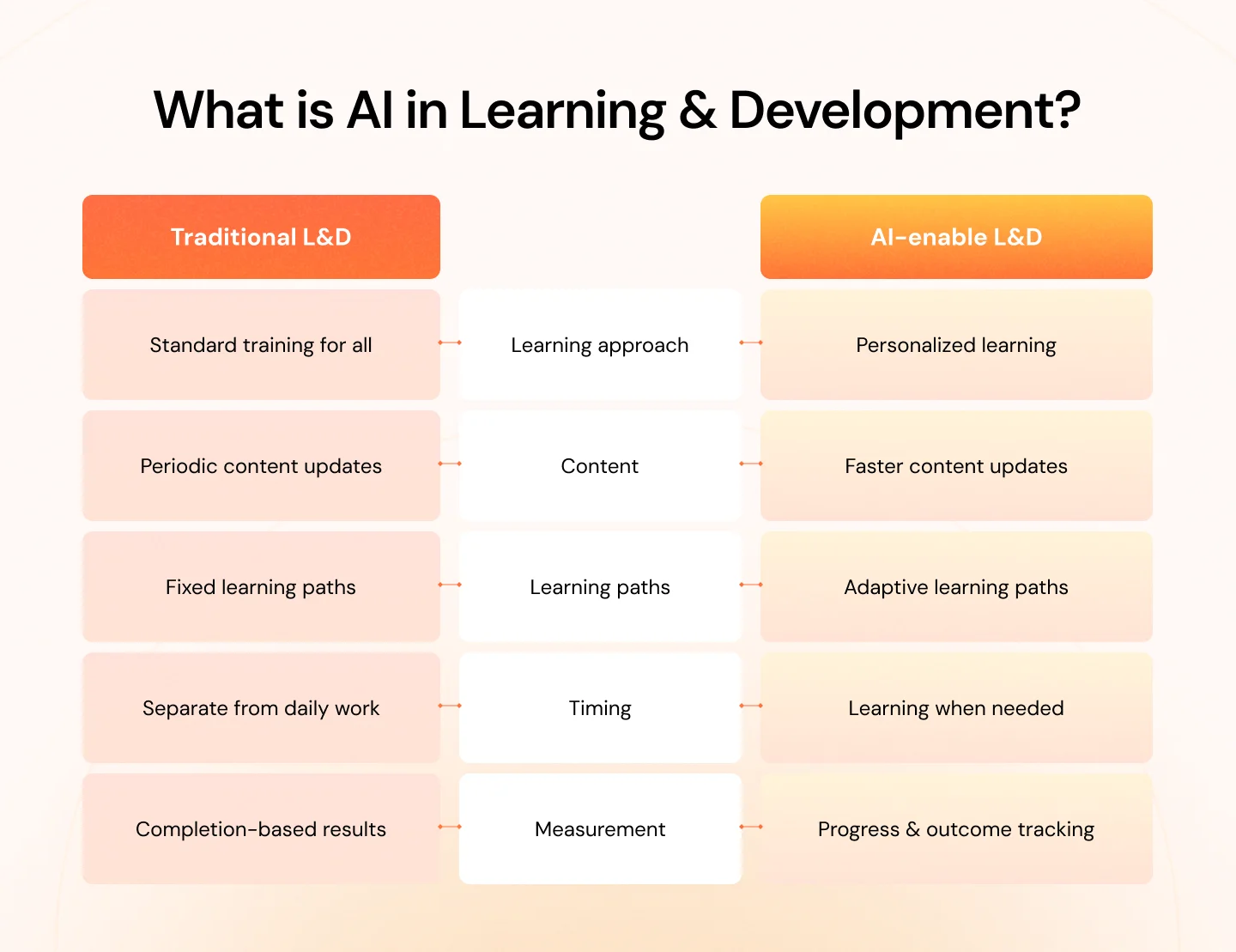
AI in Learning and Development (L&D) means using artificial intelligence to automate training tasks and personalize employee growth. Instead of manually building one-size-fits-all courses, AI analyzes skill gaps, drafts learning content from company documents, and tracks progress-cutting administrative overhead while accelerating workforce performance.
For example: AI can turn company documents into training content, recommend relevant courses, and provide practice scenarios — helping L&D teams reduce repetitive work while giving employees more relevant ways to develop their skills.
These capabilities can change how L&D works in practice, from how training is delivered to how progress is measured. To see the difference between traditional and AI-enabled L&D, take a glance at the table below:
How AI Makes Traditional Corporate Training More Effective
Traditional corporate training is not necessarily ineffective. The challenge is that many training processes were built for a workplace where roles, skills, and business needs changed more slowly.
Today, HR and L&D teams need to keep training relevant while managing changing skills, new information, and different employee needs. AI can help reduce some of the manual work involved in creating, delivering, and improving training.
AI addresses these legacy bottlenecks by modernizing 3 core pillars of corporate learning:
1. Keeping training content up to date
Creating a training program can take time because HR and L&D teams need to research the topic, create learning materials, review them, get approval, and publish the content. By the time a course is available, the information may already need to be updated, especially in fast-changing areas.
AI can help shorten this cycle by creating and updating learning materials more quickly. Existing policies, documents, and knowledge can also be turned into different formats, such as summaries, quizzes, or practice exercises.
2. Adapting learning to different employees
A new hire, an experienced manager, and technical specialists may have very different skills and development needs. Yet traditional training often starts everyone with the same course or learning path.
AI can help make learning more relevant to each employee. It can consider factors such as role, existing skills, learning progress, and development goals to recommend relevant content or determine what an employee should learn next.
3. Measuring what employees actually learn
Completing a course does not necessarily mean an employee learned or applied what was taught. A 100% completion rate only shows that employees finished the training, not whether they understood the material or retained it.
AI can help HR teams look beyond completion rates by bringing together information such as assessment results, learning activity, progress, and areas where employees need more support. This can help identify where employees are struggling and where additional training may be needed.
The result is a clearer picture of whether training is helping employees build the skills they need, rather than simply whether they completed the course.
5 Core AI Capabilities Transforming L&D
In many organizations, L&D departments often fall into the trap of “one-size-fits-all” training – spending hundreds of hours building course material only to find that employees cannot apply it on the job. AI addresses this directly by intervening at key points throughout the learning lifecycle.
Here are 5 core capabilities where AI is transforming L&D from manual administration into personalized strategy:
1. Personalized learning paths
Employees have different roles, levels of experience, and development goals, so they do not always need the same training. For example, a new hire may need to build foundational skills, while an experienced manager may need to develop leadership capabilities for a new role.
AI can help make learning more relevant by analyzing information such as an employee’s current skills, role, learning history, and development goals. Based on this information, it can recommend relevant learning content and create a learning path that better matches each employee’s needs.
For AI employee training, this means moving beyond “Everyone takes the same course” toward learning experiences that are more relevant to each employee and their development needs.
2. AI-powered training content creation
Creating training content can take significant time, especially when teams need to turn existing documents, processes, or expert knowledge into courses, quizzes, and other learning materials. This can make content creation a time-consuming part of the L&D process, particularly when materials need to be created or updated regularly.
Generative AI can speed up this process by creating first drafts of summaries, quizzes, exercises, videos, and learning modules from existing source material. This reduces manual work while allowing L&D teams to focus on accuracy, relevance, and learning objectives.
3. Skills gap analysis
Training is more useful when it addresses the skills employees and businesses actually need. AI can help HR teams compare current workforce skills with role requirements, identify development areas, and prioritize learning needs.
Beyond current gaps, AI can also help organizations consider the skills employees may need for future roles or changing business needs. This gives L&D teams a clearer basis for planning training that supports both current performance and future development.
4. AI simulation and role-play
Some skills are difficult to develop through courses alone because employees often need more than theoretical knowledge. As a result, they may need to practice making decisions, handling conversations, or responding to realistic situations before applying those skills at work.
AI simulations can create interactive scenarios where employees practice these skills in a controlled environment. The AI can respond to their choices, introduce different situations, and provide feedback, making training more focused on practice and decision-making rather than simply remembering information.
5. Learning analytics
Understanding whether training is actually helping employees requires more than tracking course completion. L&D teams also need to see how employees are progressing, where they may be struggling, and which areas need more support.
AI can analyze learning activity such as assessment results, learning progress, content engagement, and areas where employees need additional support. This shifts the focus from simply asking “Did they complete the training?” to understand “What are they learning, where are they struggling, and what should happen next?”
AI in L&D - Real Corporate Training Examples
AI is being applied to address different challenges in employee learning and development. From personalizing leadership development and adapting training to changing needs to connecting skills with workforce requirements and supporting distributed teams, AI can make learning more relevant and responsive. The examples below show how organizations are applying AI in real-world training programs.
1. Personalized leadership development
Leadership training does not have to follow the same program for every manager, because each manager has different levels of experience, strengths, and development needs. As a result, personalized training can focus on the skills and challenges that matter most to each person.
For example: AI was used to analyze employee performance, career progression, and role requirements to identify potential future leaders. Based on this information, the organization could create more personalized development programs and prepare leaders for challenges they were likely to face in the future.
2. Adaptive training for changing situations
Some industries need to update employee training quickly when procedures, regulations, or real-world conditions change. In these situations, employees may also need different information depending on their expertise and current responsibilities.
For example: A public health organization used an AI-powered training platform to adapt learning content based on employees’ expertise and current needs. This helped employees focus on the information most relevant to their roles and reduced training time by 40%.
3. Skills-based workforce development
Organizations with large and diverse workforces can use AI-powered skills mapping to connect employee skills with job requirements and learning opportunities. This helps bring employee development closer to workforce planning, so training can better reflect the skills the organization needs.
For example: AI-powered skills mapping can analyze employee profiles, job requirements, learning history, and other workforce information to identify existing skills and potential gaps. HR teams can then use these insights to recommend relevant learning opportunities and build development plans around the skills the organization needs.
4. Microlearning for distributed teams
For retail, hospitality, and other frontline teams, sitting through a long training session is not always practical. Employees may work different shifts, locations, or schedules, making traditional training harder to deliver consistently.
For example: Mobile-first learning platforms can use short lessons, quizzes, and interactive activities to make training easier to access during the working day. Some organizations have used this approach to improve participation and knowledge retention across distributed teams.
Explore Blazeup Agents to see how digital workers like Blazey can support everyday HR and L&D tasks, work with your existing tools, and help your team spend less time on manual work.
AI in L&D - Benefits and Key Considerations
While AI offers transformative potential for corporate learning, its business value depends entirely on how intentionally it is deployed. Organizations must balance operational efficiency gains against the governance required to maintain accuracy, fairness, and trust.
The Value AI Brings to L&D
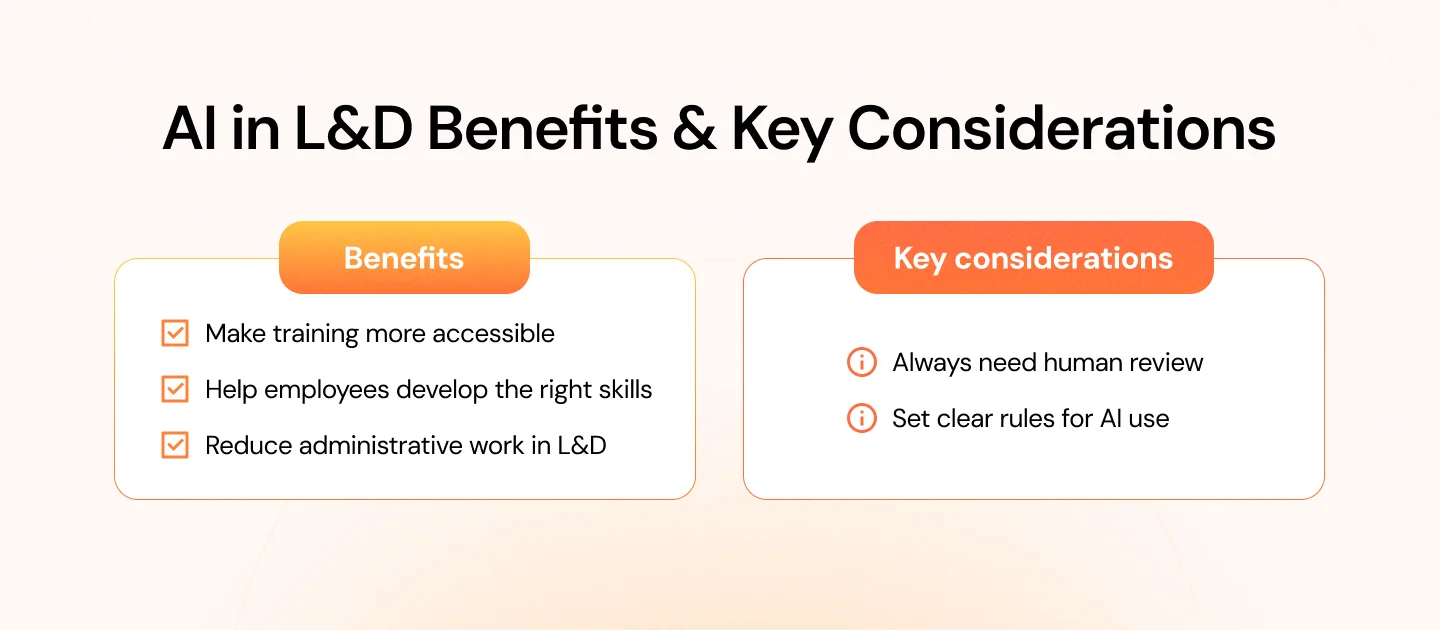
AI can support L&D teams in more practical ways, from making training easier to access to helping employees develop the right skills. It can also reduce repetitive administrative work, giving HR teams more time to focus on people.
1. Make training more accessible
AI can help HR teams create and update training materials faster, while making personalized learning easier to deliver at scale. At the same time, human review is important to ensure the content remains accurate, relevant, and aligned with employees’ needs.
2. Help employees develop the right skills
AI can use roles, skills, and learning progress to identify development needs and recommend relevant learning. At the same time, organizations need clear rules around data, fairness, and transparency.
3. Reduce administrative work in L&D
L&D teams spend a lot of time on repetitive tasks such as preparing training materials, tracking progress, and handling routine learning requests. AI can help with these tasks, reducing the manual work involved in managing training. As a result, teams can spend more time on coaching, mentoring, and supporting employee development.
What to Consider When Using AI in L&D
AI can bring more efficiency to L&D, but expanding its use also requires the right oversight. Organizations need to make sure AI-generated content and recommendations remain accurate, fair, and aligned with how they want to support employees.
1. Always need human review
AI can help create training content and recommendations, but human review is still important to maintain their accuracy and relevance. L&D teams should review AI-generated outputs to make sure they meet learning objectives and fit the needs of employees.
2. Set clear rules for AI use
As AI becomes part of L&D processes, organizations need clear guidelines for how it should be used. These guidelines should cover employee data, fairness, transparency, governance, and when human review is required, while allowing teams to adopt AI gradually.
How to Implement AI in Your L&D Function — 4 Steps
Most AI implementations fail when companies attempt a top-down, organization-wide rollout without a clear focus. To de-risk adoption and demonstrate measurable ROI, organizations should adopt a phased, problem-first rollout strategy.
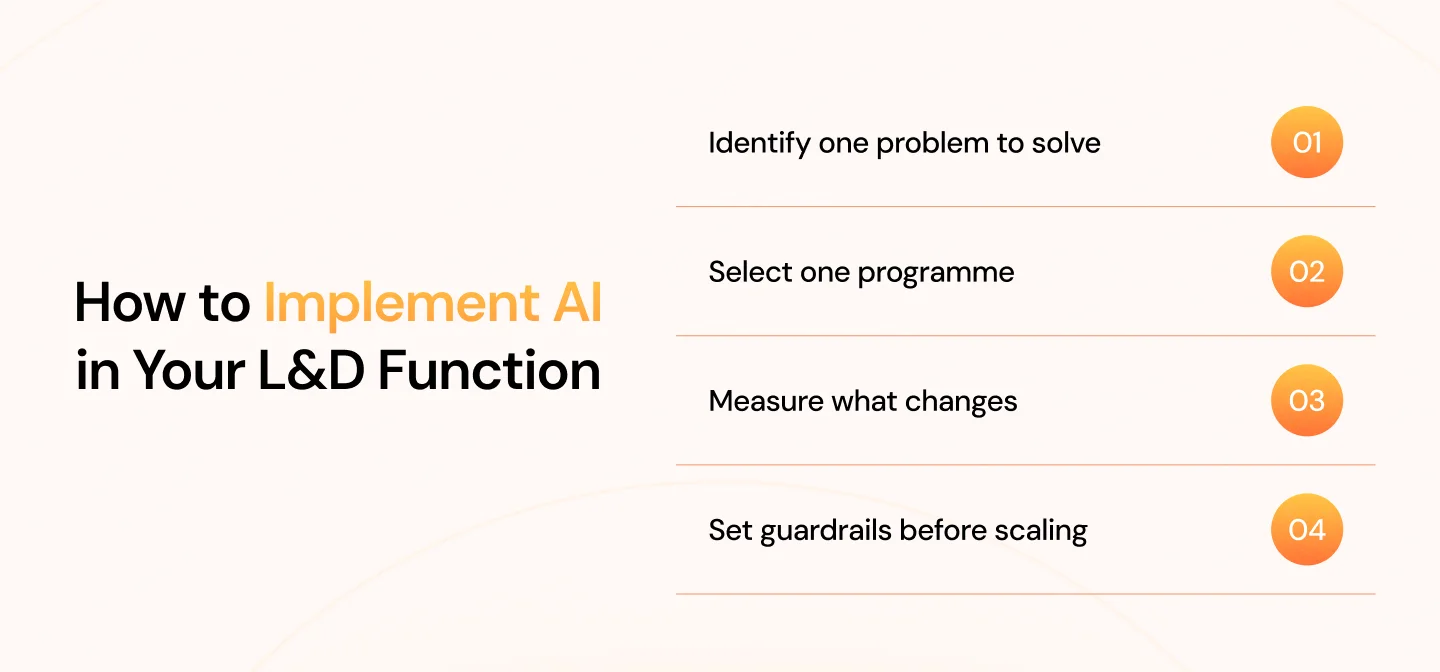
1. Identify one problem to solve
Start by looking at where the L&D team spends the most time or faces the biggest challenge, whether that is creating training content, personalizing learning, tracking completion, or identifying skill gaps. Choosing one specific problem gives the organization a clear starting point and makes it easier to evaluate whether AI is actually helping.
2. Select one programme
Choose a high-volume or frequently used training programme where AI can directly address the challenge you identified. Starting with a focused pilot gives the organization a practical way to test how AI fits into the existing process and understand how employees respond to it. Based on the results, the team can identify what works, make necessary adjustments, and decide whether to expand AI to other training programmes.
3. Measure what changes
Define clear metrics before the pilot begins to understand what has changed. These could include time spent creating training content, course completion and engagement, knowledge retention, or changes in employee performance. The goal is to measure business impact, not just AI adoption.
4. Set guardrails before scaling
Before scaling, establish clear rules around what AI can handle independently, when human review is required, who can use it, and how employee data should be managed. HR, IT, and other relevant teams should be involved in defining these guidelines and ensuring they are applied consistently.
For a fast-moving SME, a practical starting point could be AI-assisted onboarding. It is a contained use case that can help HR reduce repetitive work while building experience with AI before moving into broader learning and development initiatives.
Conclusion
AI is changing how businesses approach learning and development. Instead of treating training as a one-size-fits-all process, companies can use AI to create more relevant learning, identify skill gaps, support practice, and better understand employee progress.
The goal is not to automate everything at once. Start with one training workflow, measure what changes, and gradually expand AI’s role while keeping human judgement, coaching, and employee development at the center.
Interested in integrating AI into your L&D function?
Contact Blazeup to discuss how digital workers can support your business, streamline daily operations, and take care of routine tasks.
Frequently Asked Questions (FAQs)
AI in Learning and Development means using AI to improve how businesses plan, deliver, and manage employee training. It can help identify skill gaps, create training content, personalize learning, recommend relevant development opportunities, and track employee progress.
 Ami Tran
 Sathvik Bellave