Core HR Agent
AI in Performance Management: What It Is, How It Works & the Tools That Make a Real Difference in 2026
- 21 October, 2026
- 20 Minutes
 Jamie Ho
Table of Content
A performance review should reflect an employee’s work throughout the year, not just what a manager remembers when review time comes around.
Important details can be easy to miss. Goals may be tracked in one system, feedback shared in another, and project achievements recorded somewhere else. As a result, managers may not have a complete picture of an employee’s progress when it is time to review performance.
AI can help bring this information together, summarize feedback, track progress toward goals, and highlight areas where employees may need support. Rather than relying only on periodic reviews, HR teams and managers can use these insights to have more informed conversations about performance and development.
This article explains how AI supports performance management, explores practical applications and tools available in 2026, and examines the risks organizations should consider. It also looks at real company examples and provides steps for introducing AI into the performance management process.
What Is AI in Performance Management?
AI in performance management is the use of artificial intelligence to help organizations track employee progress, analyze performance data, and improve performance reviews. Instead of relying mainly on annual appraisals and managers’ recollections, AI will bring together feedback and performance information to provide more timely insights throughout the year.
Understanding how AI and performance management work together starts with identifying which tasks AI can support and which decisions still require human judgment. Managers remain responsible for interpreting the context, discussing feedback with employees, and making final performance assessments.
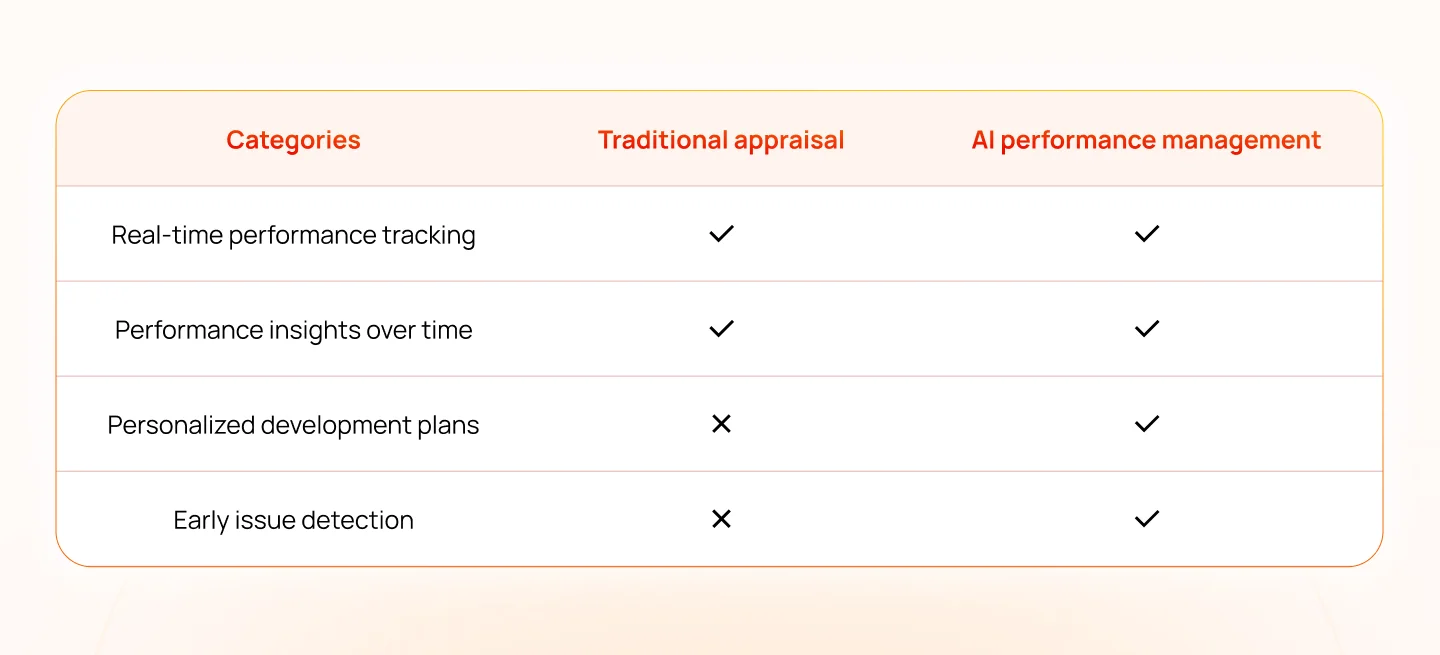
Traditional performance management often centers on annual or semi-annual reviews. Managers gather information, assess progress against goals, and provide feedback at scheduled intervals. This approach can make it difficult to capture progress consistently throughout the year, especially when feedback is scattered across documents and systems.
In contrast, AI-supported performance management can help summarize feedback, track goal progress, and identify patterns in available performance data. This gives managers a broader view of employee contributions when preparing reviews, while they remain responsible for interpreting context and making final assessments.
Why Traditional Performance Management Falls Short
Performance management should help employees understand expectations, recognize achievements, and improve their work. In practice, several recurring problems can make the process less consistent and less useful for development.
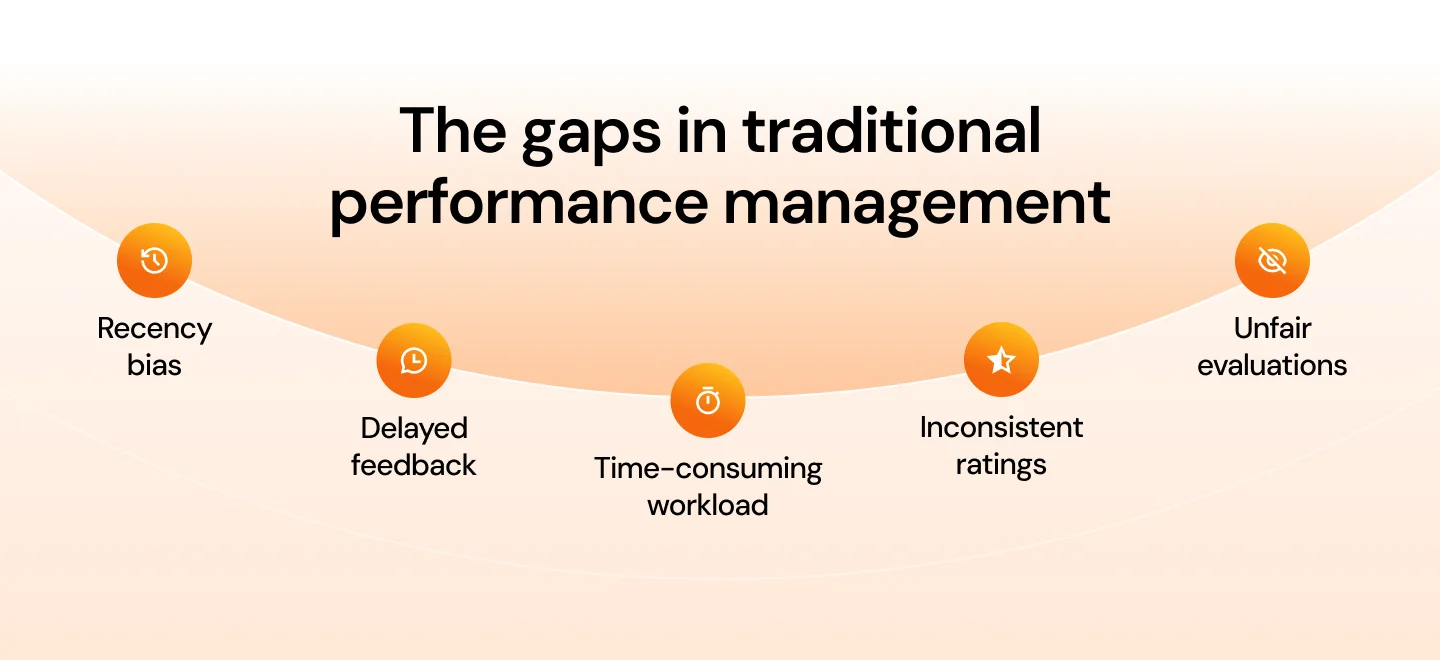
1. Recency bias: recent work overshadows the bigger picture
Managers may remember recent achievements or mistakes more clearly than contributions made earlier in the year. As a result, an employee’s latest performance may influence the assessment more than their overall contributions.
Regular feedback and documented evidence help managers build a more complete view of performance. AI can summarize available information across different periods, while managers verify that the summary accurately reflects the employee’s work.
2. Delayed feedback: feedback comes too late
Annual or semi-annual reviews create scheduled opportunities to discuss performance, but long gaps between conversations can leave employees without timely guidance. They may continue working with unclear priorities or repeat mistakes because feedback arrives too late to help them improve.
Regular performance discussions help managers recognize progress, address concerns earlier, and adjust goals when business priorities change. AI can organize feedback and goal updates to support these ongoing discussions.
3. Time-consuming workload: review preparation takes too much time
Managers often spend hours gathering feedback, checking goals, and preparing appraisal documents. When information is spread across spreadsheets, documents, and HR systems, administrative work can take time away from coaching and employee development.
AI can help summarize available feedback, organize performance information, and prepare review drafts. Managers still need to check the content, add context, and ensure that the final evaluation accurately reflects the employee’s contributions.
4. Inconsistent ratings: similar performance, different assessments
Performance ratings can vary across teams when managers interpret expectations differently. One manager may focus on measurable results, while another gives more weight to communication, visibility, or recent achievements, leading to different assessments of similar performance.
Clear evaluation criteria and structured review processes help improve consistency across teams. AI can flag vague language or differences in written evaluations, giving HR teams a starting point for further review while leaving final judgments to managers.
5. Unfair evaluations: fairness and transparency matter
Employees need to understand how their performance is assessed and what they can do to improve. When expectations are unclear, or feedback relies on subjective impressions rather than specific evidence, employees may question whether their evaluations are fair.
Consistent evaluation criteria, timely feedback, and transparent communication help build trust in the process. AI can help organize performance information and reduce administrative work, but fair assessments still depend on reliable evidence, clear standards, and human judgment.
AI in Performance Appraisal: What Changes for HR, Managers, and Employees?
Artificial intelligence in performance appraisal changes how performance information is collected, reviewed, and used throughout the appraisal cycle. Instead of relying mainly on manual preparation and periodic reviews, organizations can use AI to organize feedback, identify patterns, and support more timely performance discussions.
These changes are most visible when comparing traditional appraisal processes with AI-supported approaches. Here is how AI can reshape the performance management experience for HR teams, managers, and employees.
1. For HR teams: from administration to strategic oversight
HR teams can use AI to monitor review cycles, compare evaluation patterns across departments, and identify workforce development needs. These insights help HR prioritize follow-ups and determine where performance criteria or review processes may need closer attention.
- Review cycle coordination: Identify incomplete reviews and follow up with the responsible managers.
- Rating consistency: Flag differences in ratings or evaluation criteria across teams for further review.
- Workforce insight: Analyze consolidated performance information to identify recurring skill gaps and development needs.
HR can use these findings to refine review guidelines and workforce development plans. Before acting on AI-generated insights, HR should verify the underlying data and consider differences in team roles and responsibilities.
2. For Managers: From Blank-Page Anxiety to Structured Evaluations
Managers can use AI to prepare performance reviews by bringing together available feedback, employee achievements, and progress against goals. This gives them a starting point for evaluating contributions without relying solely on memory or manually compiling information.
- Review preparation: Generate a draft summary of employee achievements, feedback, and goal progress.
- Feedback review: Identify recurring themes and flag statements that need clearer, job-related evidence.
- Coaching plans: Turn identified improvement areas into discussion points and development goals for one-on-one meetings.
Managers must review the information, add context that AI may not capture, and discuss the findings with employees. They remain responsible for the final evaluation and any decisions about performance or development.
3. For Employees: From Annual Uncertainty to Ongoing Clarity
Employees can use AI-supported performance information to better understand feedback, monitor progress toward goals, and explore relevant development opportunities. These insights can help them prepare for performance discussions and identify practical next steps.
- Goal tracking: Review progress against agreed objectives and identify goals that may need attention.
- Feedback understanding: Organize feedback into key strengths and areas for improvement to discuss with managers.
- Development planning: Explore relevant learning resources or development activities based on identified skill gaps.
These capabilities can help employees have opportunities to clarify feedback, provide additional context, and discuss development priorities with their managers. AI-generated suggestions can inform these conversations, but development plans should reflect the employee’s goals, role requirements, and actual performance evidence.
Companies Using AI for Performance Management: Real Examples
Companies are using AI in different ways to understand employee performance, support coaching, and improve workplace productivity. While not every application is a traditional performance management system, these examples show how organizations are applying AI to performance-related activities, from employee insights to personalized coaching.
1. Disney: Using AI to support performance reviews
Disney has encouraged employees to use AI chatbots to prepare for annual performance reviews, develop work goals, and explore professional development opportunities. Employees can use AI to organize their thoughts, refine their responses, and prepare for performance discussions. They remain responsible for reviewing and finalizing their self-assessments.
For HR teams, this approach illustrates how AI can help employees reflect on their contributions and clarify development goals before meeting with managers. AI supports preparation and communication rather than independently evaluating employee performance.
2. Ralph Lauren: Incorporating AI goals into leadership performance measurement
Ralph Lauren incorporated AI-related measures into its fiscal 2026 short-term incentive plan for leadership. These measures included AI training completion rates and employee survey results on whether staff felt supported in using AI at work. According to the company’s 2026 proxy statement, its strategic scorecard targets were exceeded.
With HR teams, this approach offers a way to connect AI training initiatives with measurable workforce goals. By tracking training completion and employee feedback on AI support, HR can assess whether employees are building the skills and confidence needed to use AI at work, then identify where additional training or support may be needed.
3. Delta Air Lines: Using AI to streamline performance reviews
Delta Air Lines has introduced an AI coaching tool to help managers prepare performance reviews, structure feedback, and set goals aligned with company strategy. The tool uses Delta’s internal values and development resources to guide managers through performance discussions and support employee growth, while keeping final evaluations under human responsibility.
This example shows how AI can reduce the administrative burden of performance reviews while helping HR managers provide more structured feedback. Human oversight remains essential to ensure evaluations reflect employees’ actual contributions and development needs.
How to Implement AI in Performance Management: A 90-Day Practical Playbook
Implementing AI in performance management starts with identifying tasks that take too much time or are difficult to manage consistently. A 90-day plan gives HR teams a structured way to test AI, measure its impact, and decide whether to expand its use.
The process has three phases: assess current needs, run a pilot, and evaluate the results before scaling. Each phase helps the organization introduce AI gradually while maintaining data privacy and human oversight.
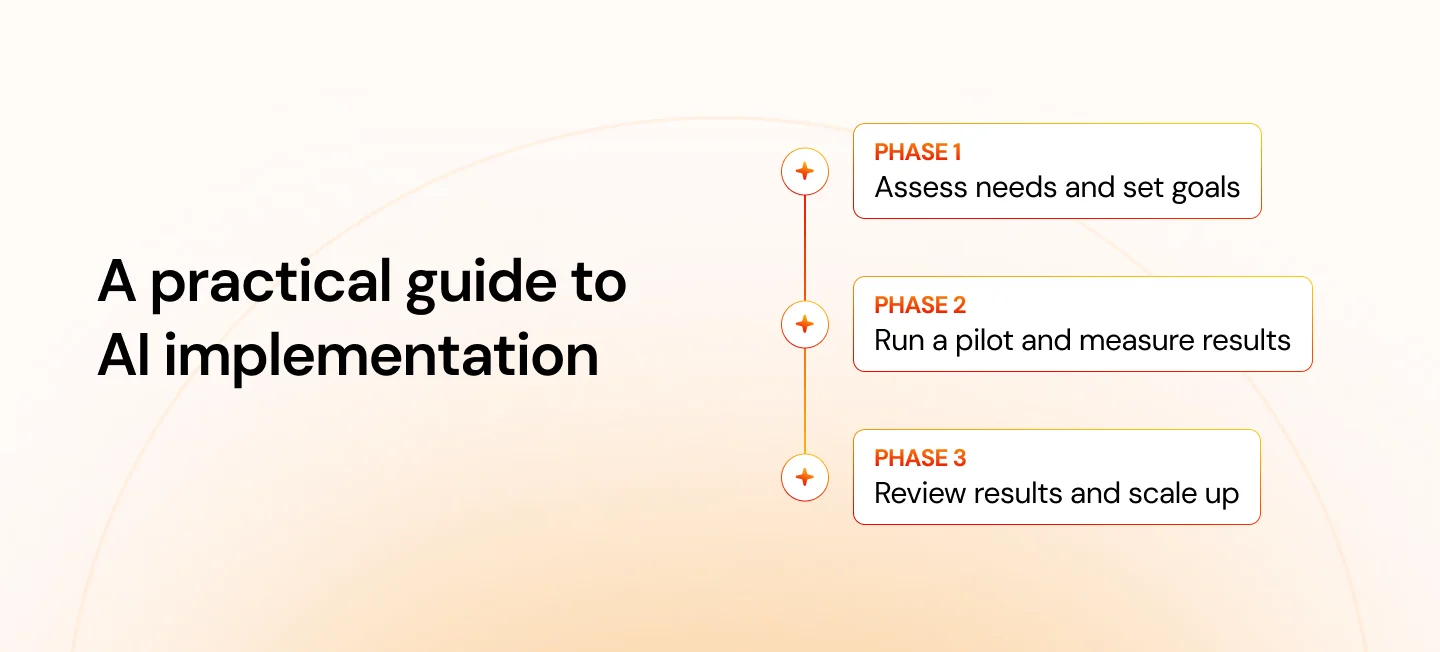
Phase 1: Assess needs and set goals (Weeks 1–2)
Review the current performance management process to identify bottlenecks and repetitive tasks. Select two or three potential AI use cases, such as preparing review drafts, summarizing feedback, or tracking goal progress.
Define success metrics and review data privacy, security, and access requirements before selecting a tool. This gives the team a clear basis for evaluating the pilot.
Key actions:
- Map the current process and identify priority use cases.
- Set baseline metrics and expected outcomes.
- Review data access, privacy, and security requirements.
Phase 2: Run a pilot and measure results (Weeks 3–8)
Test one use case with a defined employee group. A cohort of 8–50 people may be a practical starting point, depending on the organization’s size and pilot scope.
Configure the necessary integrations, train participating managers, and explain how AI will be used. Track progress weekly using metrics such as review preparation time, completion rates, output accuracy, and participant feedback.
Key actions:
- Launch the pilot with clear responsibilities and access permissions.
- Monitor KPIs and collect employee and manager feedback.
- Document errors, risks, and areas for improvement.
Phase 3: Review results and scale up (Weeks 9–12)
Compare pilot results with the baseline to determine whether AI delivers measurable value and whether identified risks can be managed. Use these findings to decide whether to expand, revise, or discontinue the use case.
If the results justify expansion, establish ongoing governance, assign clear ownership, and communicate how AI will fit into existing workflows. Train managers to use AI insights appropriately while retaining responsibility for performance decisions.
Key actions:
- Evaluate results against the original KPIs.
- Define ownership and ongoing monitoring responsibilities.
- Prepare the rollout and change management plan.
Governance checklist: Using AI responsibly
Performance management can affect employee development, promotion, and compensation. Organizations should establish safeguards that reflect their AI use cases and applicable requirements, using the NIST AI Risk Management Framework as a reference.
- Fairness: Test for potential bias and review outcomes across relevant employee groups.
- Transparency: Explain how AI is used and how its outputs inform performance reviews.
- Privacy and data minimization: Limit access to necessary employee data and protect sensitive information.
- Human oversight: Require appropriate review of AI-generated insights and define who is accountable for decisions.
- Ongoing monitoring: Track errors and unexpected outcomes, with a clear process for raising and addressing concerns.
Explore Blazeup to learn how its Core HR Agent can support HR workflows and reduce manual coordination across everyday operations.
Conclusion
AI in performance management is most useful when it helps organizations make performance reviews more consistent and turn feedback into meaningful development actions. Its value depends on how well the insights fit the company’s evaluation process, not simply on how much work the technology can handle.
For HR leaders, a practical first step is to pilot one use case, such as preparing review summaries, and measure its impact on preparation time and review quality. Clear evaluation criteria, reliable data, and human oversight should remain in place as the organization expands its use of AI.
Sounds interesting? Explore Blazeup to learn how its Core HR Agent can support HR workflows and reduce manual coordination across everyday operations.
Frequently Asked Questions (FAQs)
AI in performance management uses artificial intelligence to help organizations collect and interpret employee performance information. It supports activities such as reviewing progress, organizing feedback, and identifying development needs.